
🌿 Stories carved by wind and water
The Monarch Butterfly's Journey Defies Limits of Migration
naturePublished 21 Nov 2025
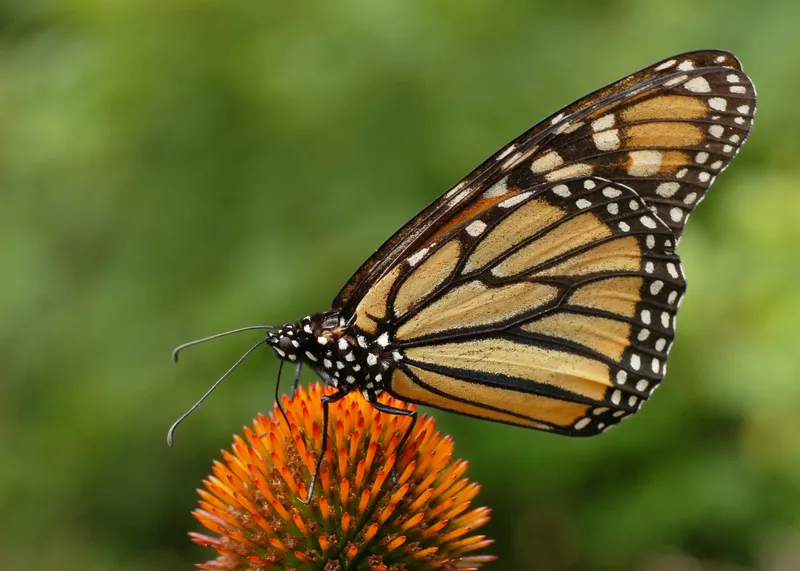
Image via Wikimedia Commons
- What: Monarch butterflies embark on a remarkable 4,800-kilometer migration from Canada to Mexico each autumn.
- Where: North America, specifically from Canada to central Mexico.
- When: Annually, during the autumn months.
- How: They navigate using environmental cues and genetic memory, returning to ancestral trees where their forebears roosted.
- Why: Their migration is crucial for biodiversity and ecosystem health, serving as an indicator of environmental conditions.
A Journey of Thousands: Nature’s Winged Travelers
Every autumn, a remarkable spectacle unfolds across North America as millions of monarch butterflies take flight. These delicate creatures, adorned with striking orange and black wings, embark on an astonishing journey of approximately 4,800 kilometers from Canada to Mexico, navigating vast landscapes and shifting climates. Their migration not only defies our understanding of distance but also challenges our concepts of endurance and instinct in the natural world. How do these fragile insects find their way back to the very trees where their ancestors roosted?
The History and Mystery of Monarch Migration
The annual migration of monarch butterflies was first documented in the 1930s, igniting fascination among scientists and nature enthusiasts alike. These remarkable insects select sites in central Mexico, such as the Monarch Butterfly Biosphere Reserve, as their winter haven. Here, nestled among forests of oyamel firs, millions huddle together, clinging to branches in a breathtaking display of survival. Records indicate that the monarch population has fluctuated dramatically, with estimates reaching as high as one billion butterflies in certain years. Yet the true wonder lies in their ability to navigate and endure arduous obstacles during migration. Like Arctic terns, which travel 71,000 kilometers from the Arctic to the Antarctic and back, monarchs exhibit an innate sense of timing and direction, relying on a combination of environmental cues and genetic memory to guide their journey. Remarkably, some monarchs return to the exact trees where their great-great-grandparents roosted, a feat that has long puzzled researchers. This ancestral loyalty hints at a deep-rooted migratory instinct, showcasing the butterfly's capacity for memory in a species known for its short lifespan—adults live only a couple of months, yet those born before winter can live up to eight months to complete their journey. These behaviors highlight an intricate link to survival; only by returning to their ancestral grounds can they continue the cycle of life.
The Enduring Relevance of Migration Patterns
The significance of these migratory patterns extends to biodiversity and ecosystem stability. Monarch butterflies not only assist in pollination but also serve as an indicator species, reflecting the health of their environments. Globally, studies show that migratory species face increasing threats due to habitat loss and climate change. The plight of monarchs resonates throughout the animal kingdom, emphasizing the interconnectedness of life on Earth. For instance, the migratory patterns of Arctic terns remind us of wildlife resilience in the face of challenges. With the loss of roosting sites and changing climates altering migration routes, understanding these patterns is crucial for conservation efforts aimed at preserving not only butterflies but also other migratory birds that share their spirited journeys. As scientists continue to explore the mechanisms behind these migrations, it becomes evident that the determination of creatures like the monarch is a testament to nature’s incredible design and resilience.
Did You Know?
Monarch butterflies are the only butterflies known to make a two-way migration, traveling up to 4,800 kilometers each year. Unlike most other butterflies, monarchs can produce a special milkweed toxin that makes them distasteful to predators. Some studies suggest that monarchs rely on a biological clock and the position of the sun for navigation during their long journeys.
Keep Exploring
CurioWire continues to uncover the world’s hidden histories — one curiosity at a time.
Sources & References
- Monarch Butterfly Biosphere Reserve — World Wildlife Fund
- Migration Patterns of Monarch Butterflies — National Geographic
- Climate Change and Migratory Species — International Union for Conservation of Nature