
🚀 Whispers from the silent cosmos
The Andromeda Galaxy's Light Shares Tales of Our Past
spacePublished 25 Nov 2025
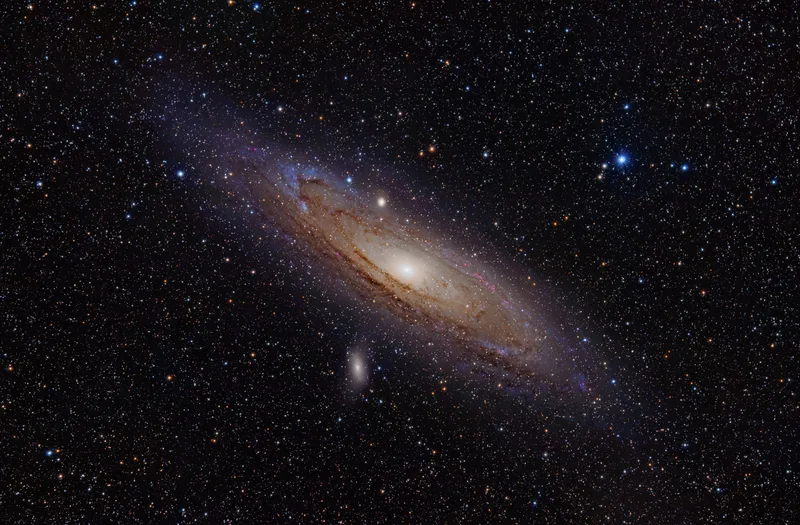
Image via Wikimedia Commons
- What: The light from the Andromeda Galaxy, having traveled for 2.5 million years, reveals ancient cosmic narratives that connect us to our origins.
- Where: Andromeda Galaxy, located approximately 2.5 million light-years from Earth
- When: Light began its journey around 2.5 million years ago during the Pleistocene epoch
- How: The light travels through space, carrying the history of stellar events and cosmic evolution
- Why: Understanding this connection enriches our appreciation of our place in the universe and our shared cosmic heritage
The Stars Above Connect Us to a Distant Past
When you gaze at the night sky, the twinkling stars seem merely decorative; yet, they serve as cosmic storytellers, weaving narratives across billions of years. The light we observe from celestial bodies far beyond our reach is not just a spectacle; it carries the echoes of history and civilization. In particular, the light from the Andromeda Galaxy, the closest spiral galaxy to our Milky Way, left its cosmic home approximately 2.5 million years ago. This mesmerizing truth invites us to consider—what stories are these ancient photons revealing about our origins as a species?
How Andromeda's Light Bridges Ages and Civilizations
To understand the significance of Andromeda's light, we must look back to the time it began its journey. Around 2.5 million years ago, Earth was entering the Pleistocene epoch, a period marked by glacial cycles and the emergence of early human ancestors, such as Homo habilis. During this time, the Aegean Sea was forming, and our ancestors were developing tools in Africa. The light from Andromeda, which spans roughly 100,000 light-years, has traversed the cosmic void at the speed of light, showcasing how interconnected the universe is across vast expanses of time and space.
Scientists from the Hubble Space Telescope team have documented that the light we perceive today is a glimpse into the distant past of Andromeda, which, like many civilizations, has undergone substantial changes throughout its lifetime. Andromeda is not merely a collection of stars; it has its own history, filled with formations, supernovae, and the intricate dance of galaxies. As the photons travel, they carry the remnants of those ancient events—stellar births and deaths—that echo the very ebbs and flows of the universe itself. This journey intertwines with our own evolutionary timeline, potentially influencing stories of survival and resilience among early humans as they navigated their world.
Understanding Our Place in Cosmic Time
The significance of this connection today lies in the light from Andromeda, which serves as a reminder of our shared cosmic heritage. As we explore the universe with modern telescopes, we find that every star flickering in our sky is a time capsule, revealing secrets about their origins that can date back millions to billions of years. Recent studies estimate that there are more galaxies in the observable universe than stars in our Milky Way galaxy, indicating a cosmos teeming with history waiting to be unraveled.
This cosmic connection fosters not only scientific curiosity but also a profound appreciation for our place in the universe. As researchers from the European Space Agency continue to investigate cosmic phenomena, they hold keys to understanding how stars like Andromeda have shaped the very dynamics of life on Earth. In a fast-paced modern world, acknowledging our tie to the cosmos imbues our lives with perspective and wonder, reminding us that we are part of a much grander narrative that stretches across time.
Did You Know?
Every star you see in the night sky is a messenger from the past, reflecting a history that stretches for millions of years. The Andromeda Galaxy is on a collision course with our Milky Way and will merge in approximately 4.5 billion years. Light from distant galaxies can help astronomers measure the expansion rate of the universe, a critical factor in understanding cosmic evolution.
Keep Exploring
CurioWire continues to uncover the world’s hidden histories — one curiosity at a time.
Sources & References
- NASA Hubble Space Telescope — Andromeda Galaxy Overview
- European Space Agency — Cosmic Heritage and Human Evolution
- American Astronomical Society — The Expanding Universe and Galaxy Formation