
🌿 Stories carved by wind and water
The Curious Oilbird's Nighttime Navigation Secrets
naturePublished 27 Nov 2025
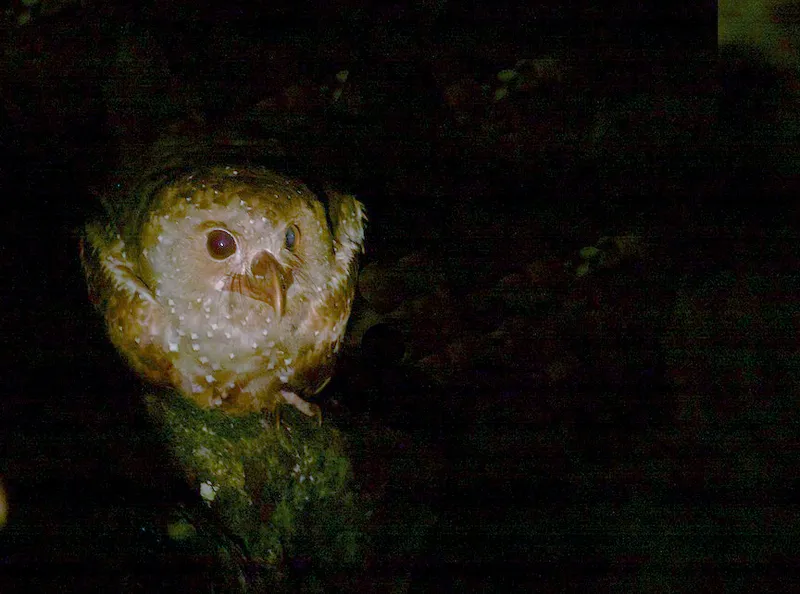
Image via Wikimedia Commons
- What: The oilbird, a nocturnal fruit-eating bird, navigates its dark habitat using echolocation rather than sight.
- Where: Tropical regions of South America, particularly Venezuela.
- When: Present day, with historical context from studies dating back to 1988.
- How: By emitting clicks that bounce off objects, allowing them to create a mental map of their surroundings.
- Why: Understanding the oilbird's unique adaptations is crucial for biodiversity conservation and highlights the ecological balance maintained by nocturnal species.
Encountering Night's Unique Nocturnal Navigators
As dusk settles, a world hidden from our daytime gaze awakens. The veil of night reveals an intricate dance of life where survival strategies shift dramatically. Among the most intriguing inhabitants of this dark arena is the oilbird, a species that eschews reliance on sight and thrives in complete darkness. Utilizing echolocation—an ability shared with bats—these fruit-eating birds navigate their nocturnal habitats with astonishing precision. Records suggest that approximately 40 species of bats rely on the same mechanism for survival, highlighting remarkable adaptability in the animal kingdom. But how does a bird that hunts in total darkness defy our natural expectations?
Unveiling the Extraordinary Oilbird Adaptation
The oilbird, found predominantly in the tropical regions of South America, exemplifies survival in the dark. These unique birds possess eyes that are not particularly adapted for night vision; instead, they rely on the sophisticated skill of echolocation to find their way and locate fruit in the dense forests they inhabit. Historically isolated in the caves of Venezuela and surrounding areas, the oilbird spends its nights foraging for palatable fruits, particularly those from the oil palm tree. Echolocation allows them to emit clicks that bounce off objects, returning echoes that inform them of their environment. This specialized adaptation became evident to researchers as they studied their foraging patterns—a striking contrast to the typical reliance of other nocturnal hunters on enhanced visual acuity. In 1988, scientists at the Universidad Central de Venezuela meticulously documented this remarkable behavior, noting that oilbirds can navigate even in complete darkness that would disorient most birds. This incredible feat prompts us to consider the broader implications of convergent evolution, where separate species, like bats and the oilbird, evolved similar adaptations to fulfill comparable ecological roles. Their evolutionary paths diverged, yet they arrived at an astonishing convergence that showcases nature’s intriguing paradoxes. Why have these birds chosen to evolve in such a radically different manner than their visually reliant peers?
The Relevance of Nighttime Adaptations in Today's Ecosystems
The significance of this adaptability lies in the vital roles nocturnal species play in maintaining ecological balance. Understanding these unique strategies sheds light on biodiversity conservation efforts worldwide. Recent studies indicate that while echolocation is primarily linked to bats, it is also being explored in other species, offering insights into their adaptations and survival in various habitats. For example, research published in the Journal of Mammalogy in 2022 draws comparisons between echolocation in bats and adaptations in other nocturnal species, emphasizing the importance of studying these dynamics. These findings remind us of our responsibility to preserve such habitats, especially as urbanization threatens the natural environments where these creatures thrive. As we continue to explore the hidden wonders of the night, we are left in awe of the extraordinary creatures that navigate its mysteries, demonstrating resilience in ways we continue to uncover.
Did You Know?
Oilbirds can produce clicks up to 20 times per second to build a mental map of their surroundings. Unlike most birds, oilbirds have a unique diet that consists almost entirely of fruits, particularly those found in Amazonian rainforests. These birds are so well-adapted to the darkness that they can forage unharmed in complete absence of light, a feat most birds would find impossible.
Keep Exploring
CurioWire continues to uncover the world’s hidden histories — one curiosity at a time.
Sources & References
- Universidad Central de Venezuela — Research on oilbird echolocation and behavior.
- Journal of Mammalogy — Studies on echolocation in bats and other nocturnal species.
- World Wildlife Fund — Conservation efforts for nocturnal wildlife and their habitats.