
🚀 Whispers from the silent cosmos
How the Andromeda Galaxy Reveals Our Cosmic Past
spacePublished 08 Dec 2025
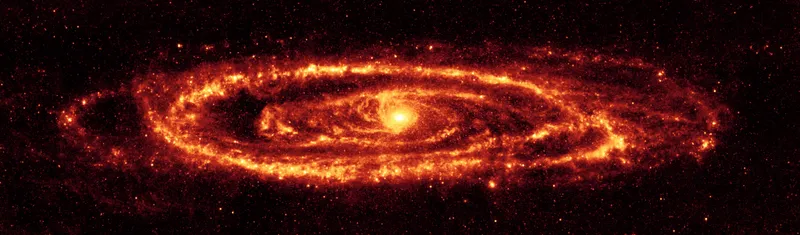
Image by NASA/JPL-Caltech/K. Gordon (University of Arizona) - Public domain
- What: The Andromeda Galaxy's light provides a glimpse into our cosmic past, originating 2.537 million years ago.
- Where: Andromeda Galaxy
- When: Approximately 2.537 million years ago
- How: Light from Andromeda travels to Earth, allowing us to observe its ancient stars and structures.
- Why: Understanding Andromeda enhances our grasp of galactic evolution and our place in the expanding universe.
Glimpses of the Cosmic Past in Our Night Sky
When we gaze at the night sky, we witness a tapestry woven from light that spans millions of years. Take the Andromeda Galaxy, for example: the light we see today left this spiral neighbor approximately 2.537 million years ago. This paradox invites a fascinating exploration of how light serves as a bridge to the distant past, shaping our understanding of cosmic history. How do these ancient echoes, these light-traveling whispers from the universe, illuminate our reality?
Andromeda: A Time Capsule in Space
The Andromeda Galaxy, known as M31, is not just the nearest spiral galaxy to our Milky Way; its light offers us a breathtaking look back in time. It takes approximately 2.537 million years for light to travel from Andromeda to Earth, meaning that each shimmering star we observe is an echo of a reality long gone. Discovered around 964 AD by the Persian astronomer Abd al-Rahman al-Sufi, Andromeda beckons both scientists and dreamers alike. Al-Sufi included it in his famous text, describing it as a “small cloud” in the night sky, but it wasn't until the early 20th century that Edwin Hubble unveiled the true scale of Andromeda, revealing that it contained billions of stars, effectively presenting humanity with its first glimpse into the vastness of the universe. The Hubble Space Telescope continually captures stunning images of this galactic neighbor, allowing astronomers to study its structure, star formation, and even the supermassive black hole at its core, known as M31*. This black hole, with a mass estimated to be between 100 and 140 million solar masses, exemplifies the complexity of cosmic dynamics, influencing the orbits of the stars nearby and acting as a reminder of how interconnected celestial bodies are across time. The cosmic dance of Andromeda doesn't simply tell the story of a galaxy; it symbolizes the shared narrative of all galaxies within the universe, each carrying tales of their histories intertwined with light that took millions of years to reach us.
Understanding Our Place in the Universe
The reason this matters today is that our observations drive the study of cosmology, delving deeper into the mysteries of the universe's origins and structure. This quest for knowledge helps us grasp our place within the cosmos. The light from Andromeda not only enriches our understanding of galactic evolution but also illustrates how the universe expands and evolves over vast timescales. Current research suggests that approximately 85% of the universe is made up of dark matter, an unseen force that affects how galaxies like Andromeda interact and evolve. As we continue to explore cosmic phenomena, the lessons learned from examining distant galaxies like Andromeda anchor our understanding of the universe's vast, evolving nature. This connection between time and space not only reshapes our scientific perspectives but also stimulates existential reflection about humanity's role in this expansive universe.
Did You Know?
When viewing the Andromeda Galaxy, you are effectively witnessing light that began its journey when our ancestors were still primitive beings, a stunning 2.5 million years ago.
The supermassive black hole at the center of Andromeda, with a mass estimated to be between 100 and 140 million solar masses, significantly influences the galaxy's structure and stability.
Astronomers estimate that within roughly 4.5 billion years, the Milky Way and the Andromeda Galaxy will collide, altering the course of both galaxies' histories.
Keep Exploring
CurioWire continues to uncover the world’s hidden histories — one curiosity at a time.
Sources & References
- NASA — Andromeda Galaxy Overview
- Hubble Space Telescope — Andromeda Galaxy Research
- Astronomical Journal — Studies on Supermassive Black Holes
#CurioWire #space #AndromedaGalaxy #lighttravel #cosmology #darkmatter #Hubble #universe #cosmicdynamics