
🌿 Stories carved by wind and water
The Remarkable Mimicry of Papua New Guinea's Octopus
naturePublished 10 Dec 2025
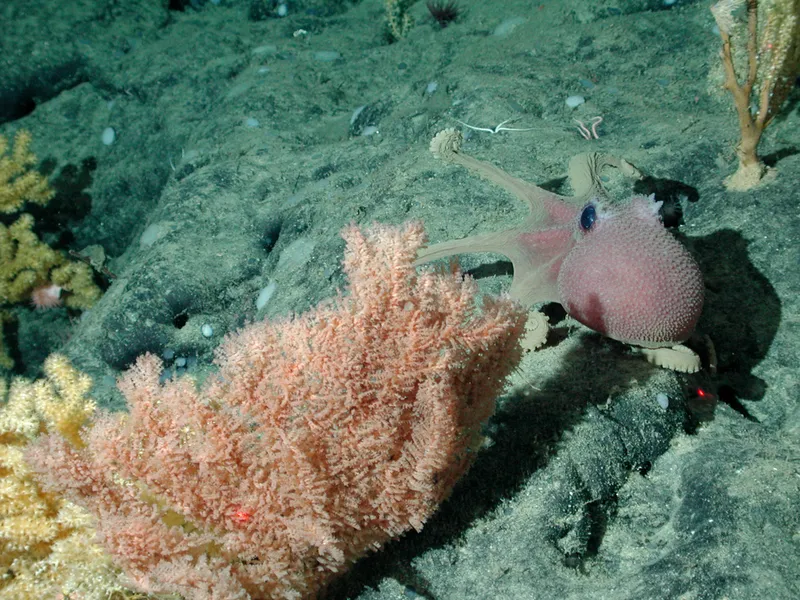
Image by National Marine Sanctuaries — Public domain
- What: The mimic octopus can impersonate various marine species, showcasing its remarkable survival strategies.
- Where: Papua New Guinea
- When: Discovered in the late 1990s
- How: Through rapid changes in body shape and color, along with behavioral mimicry
- Why: It highlights the importance of adaptability in the face of environmental changes.
Nature's Ultimate Impersonator: The Mimic Octopus
In the hidden depths of Papua New Guinea’s coral-rich waters, a marvel of evolution unfolds: the mimic octopus can impersonate a range of marine creatures, including venomous lionfish and elusive flatfish, in an uncanny display of survival tactics. This extraordinary ability allows the mimic octopus to transform its body shape and color in a remarkably short time— a spectacle that challenges our understanding of the predator-prey relationship in the ocean's depths. How did this brilliant strategist emerge from the shadows to become a master of disguise?
Unveiling the Octopus’ Astonishing Survival Mechanism
Discovered in the tropical waters off the coast of Papua New Guinea in the late 1990s, the mimic octopus (Thaumoctopus mimicus) astounds researchers with its diverse impersonations; it can convincingly adopt the appearance of several different species. Imagine drifting through a vibrant reef when suddenly, an unassuming octopus morphs into a lionfish, displaying spines that deter even the most audacious predators. This breathtaking talent isn’t just for show; according to a 2008 study published by Dr. Julian Finn, a marine biologist at Museum Victoria, this behavior showcases remarkable adaptability in the face of danger, shifting the dynamics of survival and threat in its ecosystem. Notably, the mimic octopus mimics not only physical characteristics but also behaviors—swimming like a flatfish or curling up like a sea snake, further blurring the lines between predator and prey.
The Lasting Impact of Masterful Mimicry
This extraordinary mimicry highlights an essential truth about survival in nature: adaptability can take many forms, and often, the most unexpected strategies yield the greatest results. The mimic octopus's evolution demonstrates a critical lesson in environmental adaptation that resonates with contemporary studies of other species as they contend with increasing habitat changes. As researchers explore similar phenomena in various species, such as studies on urban wildlife adjusting to cityscapes, we are reminded of the intricate threads binding all forms of life. In essence, the mimic octopus illustrates that in the grand theatre of survival, the best actors are those who can transform their roles at a moment’s notice. Could our understanding of life beneath the waves shift as more creatures reveal their own astonishing adaptations?
Did You Know?
The mimic octopus can imitate several different marine species to avoid predators, displaying unparalleled adaptability in the underwater world.
Research shows that the mimic octopus can change its body shape and coloration rapidly, brilliantly eluding danger in its vibrant coral reef habitat.
This clever cephalopod’s mimicry extends beyond physical appearances; it also employs behavioral mimicry, further enhancing its survival strategies against predators.
Keep Exploring
CurioWire continues to uncover the world’s hidden histories — one curiosity at a time.
Sources & References
- Marine Biology Journal
- Museum Victoria Archives
- Environmental Adaptation Studies