
🚀 Whispers from the silent cosmos
The Astonishing Fluctuations Revealed Near a Black Hole's Edge
spacePublished 06 Jan 2026
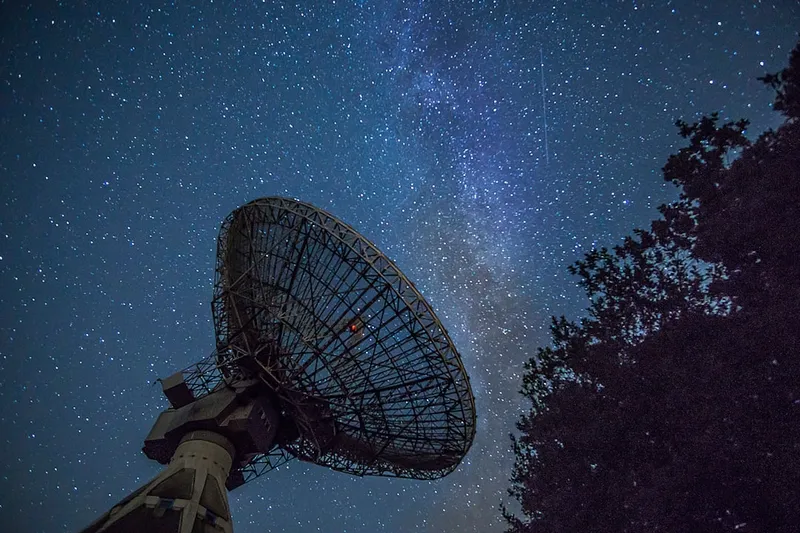
Image courtesy of Unsplash
- What: Minute fluctuations in cosmic radiation emerge near a black hole's event horizon, revealing secrets of matter caught in its grasp.
- Where: Near the edges of a black hole
- When: Contemporary research
- How: Through analysis of cosmic radiation data from the Event Horizon Telescope
- Why: These fluctuations challenge our understanding of black holes and the nature of spacetime.
Unseen Whispers of Light at the Event Horizon
As light fades near the edges of a black hole's event horizon, something extraordinary occurs: minute fluctuations in cosmic radiation emerge, potentially revealing the secrets of matter ensnared in its grasp. Researchers analyzing cosmic radiation data from the Event Horizon Telescope have documented remarkable insights into this unsettling phenomenon. In these far-flung realms of space, where Einstein's theories collide with the mysteries of the universe, we are left pondering just how much remains unknown.
Shocking Discoveries in Cosmic Radiation Analysis
The Event Horizon Telescope, a groundbreaking global network of radio telescopes, enabled scientists to capture the first-ever image of a black hole’s shadow in 2019. In doing so, they unearthed not only that haunting silhouette but also indicative signals of complex behaviors at the edge of gravitational pulls, reshaping our understanding of black holes. The interpretation of this data remains contentious, with theorists suggesting that the fluctuations detected could serve as echoes of matter spiraling toward oblivion, caught in a cosmic dance with extreme gravity. With every pulse, we catch whispers of light near the void—offering a glimpse into the incomprehensible. The tension between light and darkness at this boundary presents a paradoxical spectacle: matter and energy being transformed, obliterated, or perhaps even reborn into new forms.
The Ripple Effects of Cosmic Anomalies Today
These revelations extend far beyond mere astronomical curiosity; they challenge the very fabric of our understanding. They resonate in the minds of modern scientists grappling with the implications of information loss in black holes and the nature of spacetime itself. As we delve deeper into these enigmas, these fluctuations remind us that the universe is not a static entity but an ever-evolving tapestry woven with threads of grief and wonder. Our definitions of existence are shaped not just by what we know, but by the vast unknowns still waiting beyond the stars, compelling us to peer deeper into the infinite dark.
Did You Know?
When matter falls into a black hole, it is pulled apart by tidal forces—this process is called "spaghettification," where objects elongate and stretch due to gravitational differences.
Black holes can be classified into categories such as stellar, supermassive, and intermediate—each defined by their mass and the mysteries they hold within their grasp.
The edge of a black hole, known as the event horizon, marks the point where escape velocity exceeds the speed of light, making it impossible for anything to escape its grasp.
Keep Exploring
CurioWire continues to uncover the world’s hidden histories — one curiosity at a time.
Sources & References
- Event Horizon Telescope Collaboration
- NASA Astrophysics Division
- American Astronomical Society