
🧪 Echoes from the lab
Unexpected Changes in Liquid Crystals Under Extreme Pressure
sciencePublished 07 Jan 2026
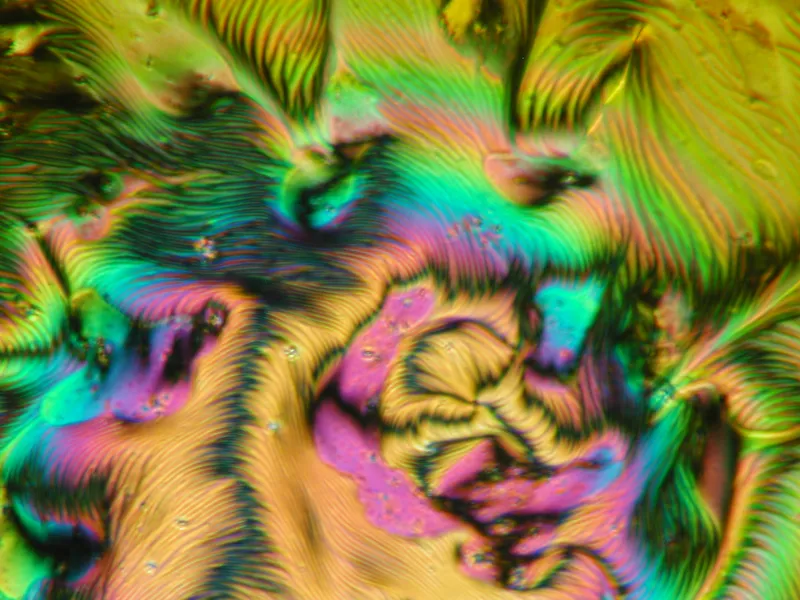
Image by Alexprague — CC BY-SA 4.0
- What: Liquid crystals display unexpected resilience under extreme pressure, maintaining organized structures.
- Where: University of California, San Diego
- When: Recent experiments
- How: Through conditions that typically disrupt conventional materials, these liquid crystals transform into geometrical arrangements.
- Why: This research challenges established norms in material science and paves the way for innovations in extreme-condition applications.
The Chaotic Truth Behind Liquid Crystal Behavior
Imagine a substance that can simultaneously embody order and chaos, ensuring stability under immense pressure while transforming into unexpected shapes. In a series of startling experiments conducted by scientists at the University of California, San Diego, researchers explored the peculiar behavior of liquid crystals when subjected to extreme pressure. Under conditions that would typically disrupt conventional materials, these liquid crystals displayed remarkable resilience, transitioning into geometrical arrangements that challenged established scientific norms. How could something so delicate withstand forces that often render other materials useless?
Resilience Amid Pressure: A Scientific Marvel
Liquid crystals, often found in screens and lasers, exist in a state that combines properties of liquids and solids. When pressure mounts, one would expect these materials to succumb to chaos, losing their novel ordered phase. Instead, the experiments revealed a counterintuitive phenomenon: some liquid crystals demonstrated an astounding ability to maintain organized structures. This curious resilience under pressure not only transforms our understanding of material behaviors but also raises questions about the fundamental principles of phase transitions. Scientists now grapple with how pressure can shift the balance, turning order into chaos without the predictable spirals of disintegration normally observed in other materials. The implications of this research extend far beyond laboratory walls; they challenge decades of established thought around material science and its predicted responses to stress.
Why Understanding These Phenomena Matters
In our modern world, the demand for materials that can withstand extreme conditions is escalating, from aerospace engineering to electronics. The surprising findings about liquid crystals offer a blueprint for future innovations that require robust and adaptable properties. As researchers delve into the phenomena behind these unexpected transformations, the potential for new applications arises, promising to unlock more resilient technologies. This revelation is not just about liquid crystals; it hints at a broader understanding of how materials might behave when pushed to their limits. If scientists can decode these complex mechanisms, who knows what other surprises await in the realms of physics and materials engineering?
Did You Know?
Some liquid crystals can exhibit unique phase transitions, adapting their structure under varying temperature and pressure conditions.
Experiments showed that, intriguingly, even at pressures exceeding 1,000 atmospheres, certain liquid crystals maintained organized phases typically reserved for lower stress levels.
The discovery of liquid crystals under high pressure not only defies expectations but also opens up new avenues for future technological advancements.
Keep Exploring
CurioWire continues to uncover the world’s hidden histories — one curiosity at a time.
Sources & References
- University of California, San Diego Research Archive
- Journal of Materials Science
- American Physical Society