
🎭 Fragments from the heart of civilization
The Colorful Patterns That Shape a Festival's Identity
culturePublished 12 Jan 2026
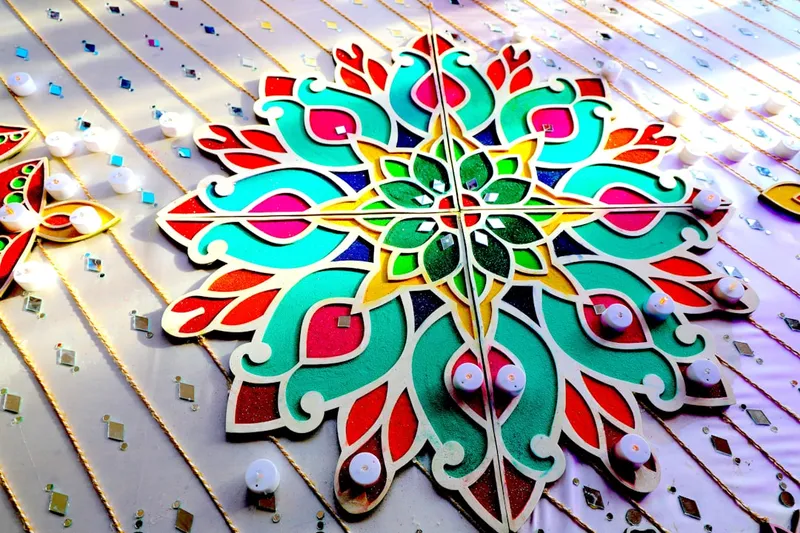
Image courtesy of Unsplash
- What: Rangoli patterns serve as intricate symbols of cultural identity during Diwali.
- Where: India
- When: During the Festival of Lights, Diwali
- How: Crafted from vibrant powders, petals, and rice flour, these designs convey layered meanings.
- Why: They foster dialogue on inclusion and reclaim narratives within the festival's rich tapestry.
Intricate Designs of Light and Meaning
As twilight descends, the streets of India transform into a canvas alive with color and light. Rangoli patterns—intricate, symmetrical designs—are meticulously crafted on entranceways, made from vibrant powders, petals, and even rice flour. This ritual, which dates back to the 4th century, serves not merely as decoration, but as an offering of welcome during Diwali, the Festival of Lights. Each swirl and dot resonates with layers of significance waiting to be unveiled, hinting at deeper narratives of identity, festivity, and inclusion.
Rangoli Patterns as Symbols of Heritage and Identity
The act of creating rangoli is infused with cultural semiotics—each pattern tells a story that varies from region to region, reflecting local beliefs and communal experiences. In the heart of Maharashtra, for instance, beautiful floral motifs symbolize prosperity, while in Tamil Nadu, intricate geometric designs speak to the precision of friendship and community. These patterns of meaning often serve as a canvas for dialogue, particularly among marginalized voices seeking to reclaim their narratives within the larger framework of Diwali festivities. A striking realization emerges: the very act of interpretation creates an echo, a conversation that transcends generations. The colors, once overlooked, transform into a kaleidoscope of identity, revealing a vital truth—Diwali is as much about shared memory as it is about individual expression.
Its Echo Remains in Our Cultural Landscape
Its echo persists because the festival continues to inspire artistic expressions that challenge conventional narratives of inclusion. Artists today resurrect traditional forms while infusing contemporary themes, turning rangoli into medium statements about social justice and communal harmony. They reclaim the festival's vibrancy as a testament to resilience and identity against a backdrop of broader societal debates. The blooming patterns, once confined to the earth, now float through the discourse of art, intertwined with the essence of shared heritage. In this merging of past and present, Diwali reveals itself as a living tapestry, a celebration rich with hope and layered meanings.
Did You Know?
The creation of rangoli patterns varies significantly among different communities, with designs often unique to geographic regions, reflecting local traditions and artistry.
In some regions, rangoli is also used to mark religious occasions—not just Diwali—highlighting its role as a versatile cultural expression beyond a single celebration.
The vibrant colors used in rangoli, derived from natural materials like turmeric and flower petals, symbolize joy and prosperity, inviting positive energy into homes and communities.
Keep Exploring
CurioWire continues to uncover the world’s hidden histories — one curiosity at a time.
Sources & References
- National Museum of India
- Journal of South Asian Studies
- Indian Art History Archive