
🚀 Whispers from the silent cosmos
Why Saturn's Rings Look So Bright From Earth
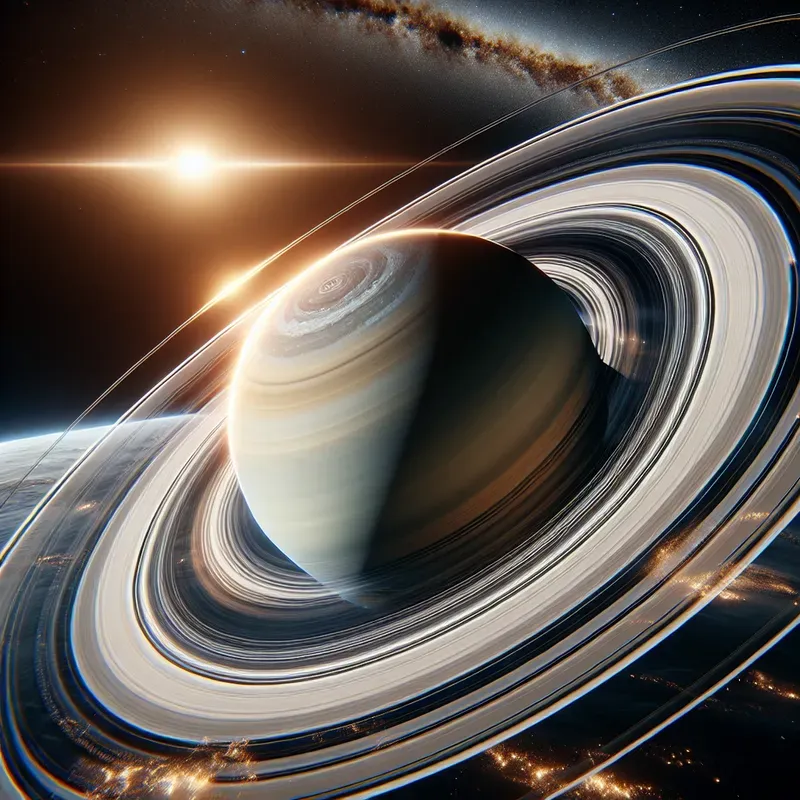
- What: Saturn’s rings look so bright because they are made mostly of reflective water ice, spread across a vast ring system that is very thin.
- Where: Saturn, in the solar system.
- When:
Saturn’s rings stand out because they are made mostly of water ice, one of the most sunlight-reflective materials in the solar system. They do not shine on their own. What we see from Earth is sunlight bouncing off a vast ring system and back into space.
Why the Rings Look Bright
That brightness can be misleading. The rings look like thick, solid bands, but they are anything but. They span roughly 175,000 miles across, yet average only about 30 feet thick. In other words, Saturn’s rings are enormous in area but surprisingly slight in depth, more like broad, bright sheets than heavy slabs circling the planet.
Their visibility from Earth comes from that combination of scale and composition. Even though Saturn is far away, the rings present a huge reflective surface. Ice reflects sunlight efficiently, and spread across such a large system, that adds up to a feature that can be seen with modest telescopes under the right conditions.
Icy Makeup and Scale
A common misconception is that the rings are bright simply because there is a lot of material there. The more important detail is what that material is. If the rings were made mostly of darker rock or dust, they would not catch the eye in the same way. Their icy makeup is a big part of why Saturn became the planet most people can identify at a glance through a telescope.
The rings matter for more than appearance. Scientists study them because they may preserve clues about Saturn’s past and the history of its moons. One idea is that the rings formed from the remains of a moon that broke apart under Saturn’s gravity. Their origin is still an active question, but the ring system is more than decoration: it is a large, reflective record of processes that shaped the Saturn system.
Why Saturn’s Rings Matter
The hard fact is that Saturn’s most famous feature owes its brightness to a simple combination of physics and scale: sunlight, water ice, and a ring system wide enough to be visible from Earth despite being astonishingly thin.
Did You Know?
Saturn’s rings are made up of countless particles ranging from tiny grains to large chunks of ice and rock.