
🚀 Whispers from the silent cosmos
The Sun: The Gravitational Titan of Our Solar System
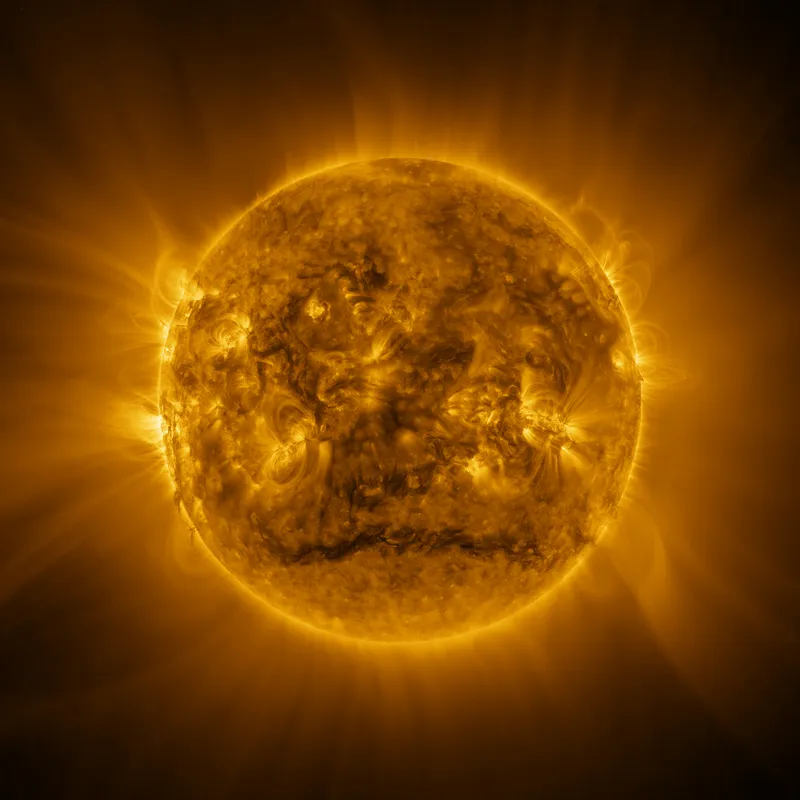
- What: The Sun, which makes up about 99.86% of the solar system's mass, exerts a gravitational pull that keeps planets and other celestial bodies in orbit.
- Where: In our solar system.
- When: Throughout billions of years.
Imagine a colossal ball of fire, so massive that it holds our entire solar system in its grasp. The Sun accounts for about 99.86% of the total mass of the solar system. That's right—almost all of it!
This immense mass generates a gravitational pull strong enough to keep eight planets, numerous moons, and countless asteroids in orbit around it. Without the Sun's gravity, our planets would drift aimlessly through the vastness of space.
But how does this work? Gravity, the force that attracts two bodies toward each other, is determined by mass. The Sun's sheer size creates a gravitational field that influences the motion of everything nearby. The closer a planet is to the Sun, the stronger the gravitational pull it experiences.
For instance, Mercury, the closest planet to the Sun, travels at a blistering speed, completing an orbit in about 88 Earth days. Meanwhile, Neptune, the farthest planet, takes about 165 Earth years to make a single trip around our star.
In essence, the Sun is not just a source of light and warmth; it is the anchor of our solar system, shaping the paths of celestial bodies for billions of years. Its gravitational influence is a reminder of how interconnected everything in space truly is.
Did You Know?
The Sun is approximately 4.6 billion years old, formed from the gravitational collapse of a region within a large molecular cloud.