
🌿 Stories carved by wind and water
Naked Mole-Rats and the Biology of Cancer Resistance
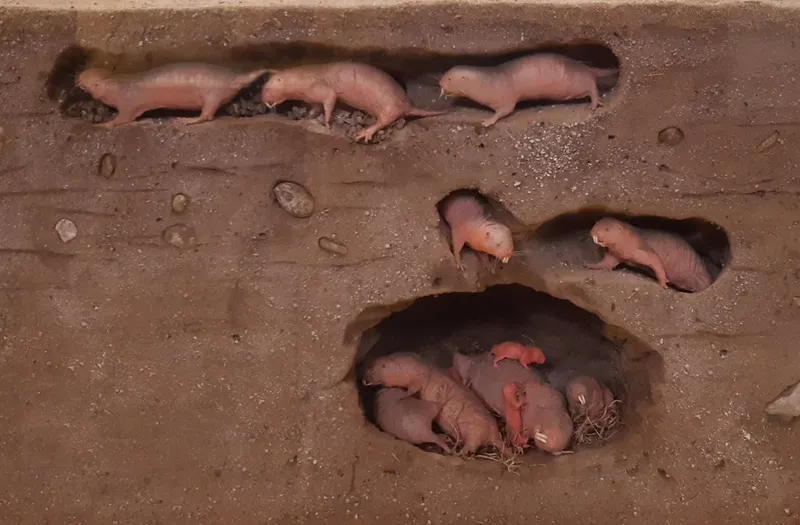
- What: Naked mole-rats are studied for an unusual resistance to cancer that has been linked to high-molecular-mass hyaluronan in their tissues.
- Where: East Africa
- When:
Naked mole-rats do not look built for durability. They are nearly hairless, spend their lives underground, and belong to a group of animals not usually associated with exceptional health. Yet they have become a major subject of cancer research because they show an unusual resistance to the disease.
High-Molecular-Mass Hyaluronan
A leading explanation centers on a substance in their tissues called high-molecular-mass hyaluronan. Hyaluronan is not unique to naked mole-rats, but the form found in these animals appears to be unusually large. Research has suggested that this material helps shape the environment around cells in a way that limits the kind of uncontrolled growth associated with tumors.
That makes the naked mole-rat interesting for a specific reason, not a mystical one. The point is not that the species is somehow immune to every threat, or that it has handed scientists a ready-made cure. The interest lies in a defined cellular mechanism that seems to interfere with tumor formation under laboratory conditions. In studies, researchers found that when this high-molecular-mass hyaluronan was reduced, cells became more vulnerable to changes linked to cancer development.
How Cancer Resistance Works
This matters because cancer resistance is often discussed in broad terms, as if it were a single trait. In practice, it can come from particular biochemical systems that alter how cells behave. Naked mole-rats offer a rare case in which one such system appears unusually prominent. Their biology gives researchers a way to study how tissue structure, cell signaling, and growth control might work together to suppress malignancy.
Why Researchers Study Them
The human relevance remains cautious rather than immediate. Findings from one species do not transfer neatly into medicine, and laboratory observations are not the same as a treatment. Even so, the naked mole-rat has become valuable as a model organism precisely because its resistance does not seem accidental. In a small burrowing rodent from East Africa, researchers have found a concrete example of how evolution can produce a built-in barrier against cancer, and that makes it worth close attention.
Did You Know?
Naked mole-rats are one of the few known eusocial mammals, living in colonies with a division of labor similar to ants or bees.