
🎭 Fragments from the heart of civilization
The Vatican's Bronze Pigna and the Long Afterlife of an Ancient Fountain
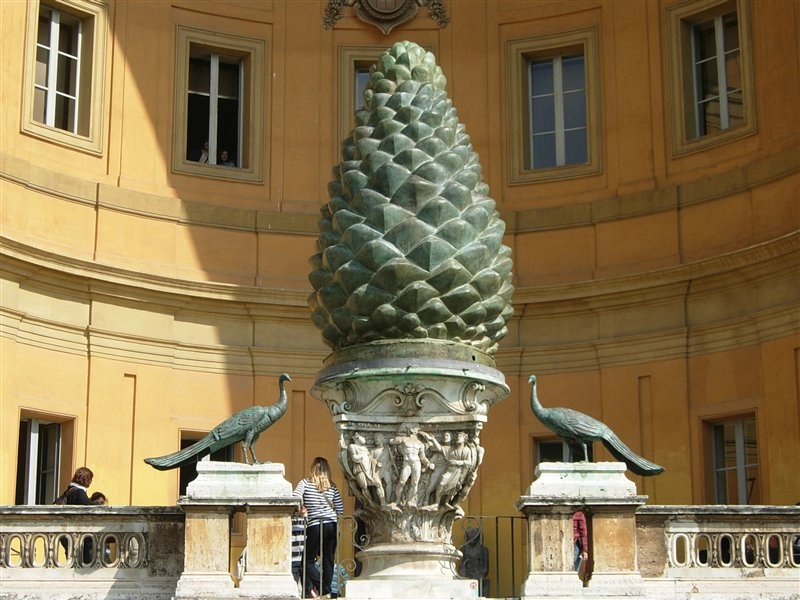
- What: The Pigna is a nearly four-meter-tall bronze pine cone that began as a Roman fountain ornament and was later reused as a Vatican landmark.
- Where: The Cortile della Pigna in the Vatican Museums complex, after earlier placement in the atrium of Old St. Peter’s Basilica.
- When: Probably from the 1st or 2nd century AD, with its move to the Vatican courtyard occurring in the early 17th century.
The Pigna is a bronze pine cone nearly four meters tall, and it now sits in one of the Vatican’s best-known courtyards. For all its prominence, it did not begin as a Vatican monument. It appears to date to the Roman imperial period, probably the 1st or 2nd century AD, and is generally understood to have been made as part of a fountain.
Roman Fountain Origins
That origin matters because the object still carries the logic of ornament rather than statuary. It was made to crown or structure flowing water, not simply to be viewed in isolation. The pine cone form is highly worked, monumental, and unmistakably decorative, but its scale also suggests the ambitions of Roman public design: even a fountain element could be cast on a size that now reads almost as sculpture.
At some point after antiquity, the Pigna entered a different setting. It was placed in the atrium of Old St. Peter’s Basilica, where an ancient object from Rome became part of the fabric of a major Christian site. That shift is one reason the piece remains so compelling. It is not only a survival from the Roman world. It is also evidence of how older works were reused, relocated, and absorbed into later environments rather than left fixed to their original function.
From Old St. Peter’s to the Vatican
In the early 17th century, the Pigna was moved again, this time to the Cortile della Pigna, the courtyard that now takes its name from the object itself. The relocation did more than give it a new backdrop. It turned a former architectural feature into a focal point. What had once likely belonged to a fountain became a central visual marker within the Vatican Museums complex.
That long sequence of moves helps explain the Pigna’s appeal. Visitors often encounter it as a singular artwork, but its history is less about solitary genius than about continuity through reuse. The bronze pine cone has outlasted the setting it was made for, the basilica atrium that later housed it, and the centuries that reassigned its meaning. Its present role in the Vatican is therefore exact and paradoxical at once: an ancient Roman fountain ornament that now defines a Vatican courtyard.
Did You Know?
The courtyard where it now stands is named after the Pigna itself.