
🧩 Fragments from the unknown
Photos from Andrée's 1897 Arctic Expedition Were Found in 1930
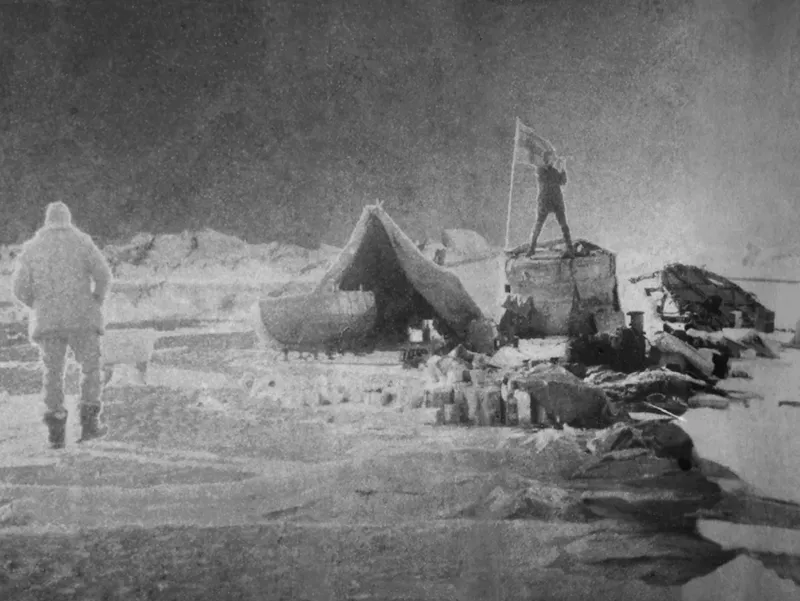
- What: Undeveloped photographic negatives from Salomon August Andrée’s 1897 Arctic balloon expedition were found on Kvitøya in 1930 and later developed, providing a rare visual record of the lost journey.
- Where: Kvitøya, an Arctic island in Svalbard.
- When: Found in 1930; the expedition dated to 1897.
In 1930, searchers on Kvitøya uncovered one of the strangest physical records left by a lost expedition: undeveloped photographic negatives from Salomon August Andrée’s 1897 attempt to reach the North Pole by balloon.
The expedition had set out with an ambitious plan and then vanished into the Arctic. For decades, its end remained uncertain. What turned up on Kvitøya did not solve every question, but it changed the story from rumor and absence into something documented. The negatives had survived the cold along with remains linked to the party, preserved well enough to be developed more than thirty years after they were exposed.
Recovered Arctic Negatives
When those images were processed, they offered a rare final record from a journey that had become a mystery. The photographs showed the men and the landscape around them, not as legend had imagined them, but as the camera had fixed them at the time: still in the field, still working, still moving through an environment that had already defeated their original plan.
That mattered because Andrée’s expedition was not a routine polar journey. It was an early aerial attempt on the Pole, a project built on confidence in new technology and the era’s appetite for geographic firsts. Its failure was already known in broad terms. The recovered images gave that failure a more exact human scale. They did not just represent an expedition that was lost; they preserved fragments of what the expedition actually looked like after it had gone wrong.
What the Photos Revealed
The discovery also narrowed the distance between the event and its aftermath. Instead of relying only on later reconstruction, historians and the public had visual evidence carried forward from 1897 itself. In that sense, the negatives were not just relics. They were part of the expedition’s own unfinished record, delayed by ice and time.
Kvitøya remains tied to that ending. The island is where the traces of the expedition were finally recovered, and where one of polar exploration’s most persistent disappearances became, at least in part, visible.
Did You Know?
The recovered images are now associated with one of the earliest known photographic records from a failed North Pole expedition.