
🧩 Fragments from the unknown
The Ishango Bone and the Debate Over What It Meant
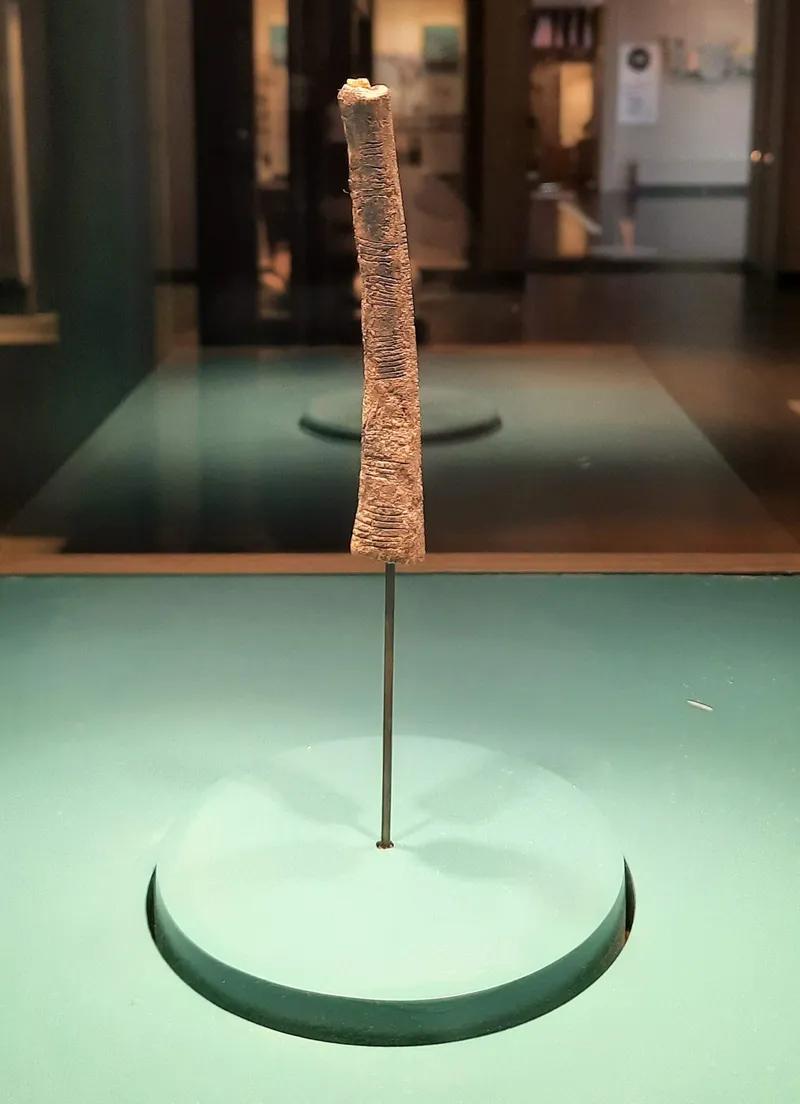
- What: The Ishango bone is a prehistoric carved bone whose notch patterns have been interpreted as counting marks, a lunar calendar, or an early mathematical tool, but its original purpose remains uncertain.
- Where: Central Africa.
- When: Roughly 20,000 years ago; it was discovered in the 1950s.
The Ishango bone is a small prehistoric artifact from central Africa, dated to roughly 20,000 years ago, and its significance rests on a set of deliberate marks cut into its surface. Since its discovery in the 1950s, those markings have drawn repeated attempts at interpretation. The basic fact is clear: someone made a patterned series of notches. What that pattern was for is where the debate begins.
Counting Marks or Calendar
One common reading is practical. The marks may have been a way to count, track quantities, or keep some kind of running record. Another interpretation goes further, suggesting the notches reflect awareness of recurring cycles, possibly even the phases of the moon. That idea is part of what made the Ishango bone famous: it raised the possibility that prehistoric people were not only recording numbers, but also organizing time.
Still, the strongest claim often attached to the object—that it is proof of early astronomy—is not settled. The bone is intriguing precisely because the notches can support more than one explanation. Some researchers have treated it as an early mathematical tool. Others have argued for a calendar-like function. Neither view has closed the case. The object survives, but the context around its original use is limited, and that makes certainty hard to reach.
Why the Debate Continues
That uncertainty matters because the Ishango bone is sometimes presented too neatly, as if scholars uncovered a prehistoric observatory in miniature. What exists instead is a marked bone with a pattern suggestive enough to sustain decades of argument. It may point to counting. It may reflect an attempt to track regular natural rhythms. It may have served a purpose that no modern label fits especially well.
What the Ishango Bone Suggests
Even in the most cautious reading, the artifact complicates simple assumptions about prehistoric life. It suggests attention, repetition, and some need to preserve information outside memory alone. Whether that information concerned numbers, time, or something else entirely remains unresolved. The Ishango bone is compelling not because it has already yielded a clean answer, but because a very old marked object still resists one.
Did You Know?
The artifact was found near the headwaters of the Nile, in what is now the Democratic Republic of the Congo.