
🌍 Records from the halls of power
The Medusa Heads Beneath Istanbul's Basilica Cistern
- What: The Basilica Cistern in Istanbul contains two reused Medusa heads that have become among its most debated and recognizable features.
- Where: Basilica Cistern, Istanbul, Turkey.
- When: The cistern dates to the 6th century Byzantine era.
Deep under Istanbul, the Basilica Cistern is one of the city’s most striking survivals from the Byzantine era: a vast underground reservoir supported by 336 columns. Its scale is impressive on its own, but two column bases near the back of the space tend to hold visitors a little longer than the rest.
Medusa Heads in the Cistern
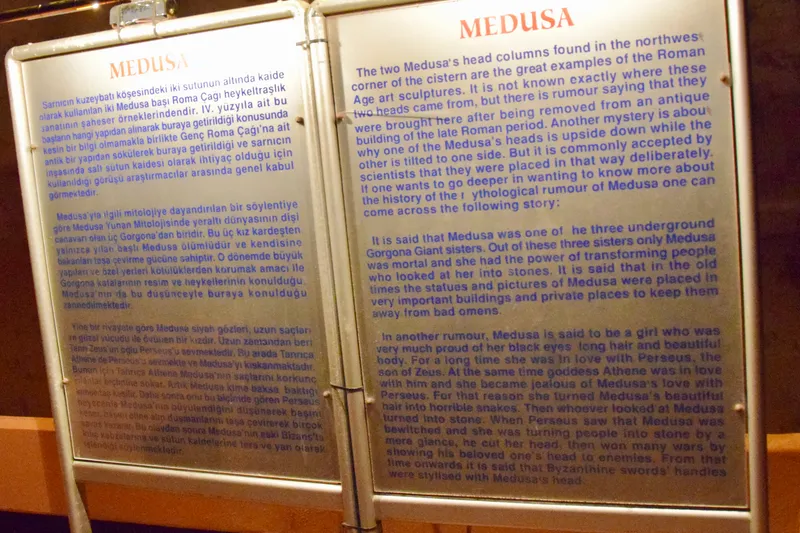
Each is carved with the face of Medusa. One head lies on its side. The other is inverted. Their odd placement has helped turn them into one of the cistern’s most discussed details, not because anyone knows exactly why they were arranged that way, but because the possibilities say a lot about how ancient materials were reused.
The cistern dates to the 6th century and was built as a water source for the Great Palace of Constantinople. The Medusa heads, however, appear to have come from somewhere else and been repurposed as supporting blocks. That alone makes them notable. They were not created for this underground setting, yet they now define it.
Why They Were Reused
Over time, explanation gave way to legend. A common idea is that the sideways and upside-down positions were meant to cancel Medusa’s mythical power, reducing the force of her gaze and turning a feared figure into a harmless architectural element. It is a memorable theory, though not a settled one. Practical reuse may be the simpler answer.
That uncertainty is part of the appeal. The heads sit at the intersection of engineering, mythology, and the long afterlife of stone. In the Basilica Cistern, carved fragments from an older visual world were folded into the infrastructure of a later empire. What survives is not just a feat of water storage, but a record of how cities are built from what they inherit.
Meaning Beneath Istanbul
The Medusa bases are a small part of the cistern, yet they sharpen the whole place into focus. They remind visitors that beneath Istanbul, utility and symbolism were never fully separate, and that even a structural support can carry stories far beyond its original purpose.
Did You Know?
It was built to supply water to the Great Palace of Constantinople.