
🏺 Recovered from the dusty archives
7 WWII Decoys That Tricked Enemy Pilots
- What: The article surveys how World War II combatants used visual decoys, camouflage, smoke, and staged effects to mislead enemy reconnaissance and bombing.
- Where: Primarily across European and North African war zones.
- When: During World War II (1939–1945).
In World War II, not every target was real. Some runways were fake, some tanks were inflatable, and some fires were lit on purpose.
The goal was brutally simple: make enemy pilots see what defenders wanted them to see. These seven deception schemes turned empty ground into bait and illusion into protection.
1. Q-Sites: Dummy Airfields and Lighting Decoys
In Britain, Q-sites were built to look like active airfields at night. Mock runways and carefully arranged lights gave Luftwaffe crews something convincing to aim at from above.
What made the trick work was the follow-through. Decoy fires could simulate bomb damage, helping the fake field look like a real base under attack while real airfields stood a better chance of escaping the raid.
2. Operation Bertram’s Inflatable Armour
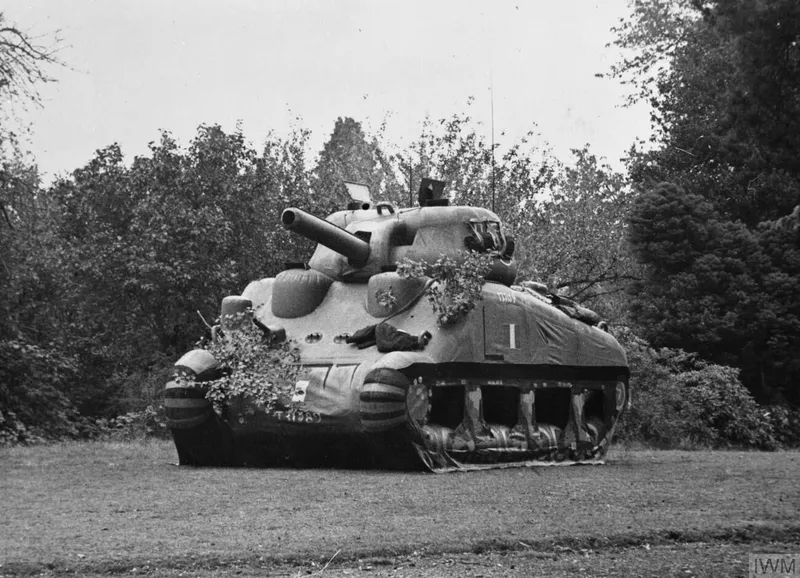
Before El Alamein, the Allies staged a visual lie on a huge scale. Inflatable tanks, wooden trucks, dummy guns, and even a fake pipeline suggested that strength was building in one sector.
The real shock is how many different props worked together. Reconnaissance did not just see fake armor; it saw an entire story of where the offensive seemed to be forming, while the real buildup was concealed elsewhere.
3. Starfish Sites: Nighttime Fire Decoys
Starfish sites took deception into the dark. In remote areas, British crews ignited controlled fires and created glow effects that imitated the look of a city already being bombed.
From the air, that false blaze could feel like confirmation. German night bombers looking for urban targets could be drawn toward these manufactured fire zones instead of the real cityscape.
4. Operation Fortitude’s Dummy Invasion Army
Operation Fortitude may be the most famous visual fake of the war. Dummy camps, vehicles, and supporting radio deception were used to sell the idea that the main invasion would strike Pas-de-Calais, not Normandy.
What stands out is that the fake army was not just scenery. It was backed by signals, staging, and command-level theater, creating a picture strong enough to influence how Germany read the invasion threat.
5. Decoy Port Lighting and Smoke Screens
Ports were some of the most valuable targets in the war, so defenders tried to hide the real ones and invent false ones. Decoy lighting could mimic docks and factories along the coast.
At the same time, dense smoke screens concealed actual harbours and convoys from bombers and spotters. One method created a tempting target; the other erased the real one from view.
6. Axis Camouflage and Soviet Maskirovka
Deception was not an Allied monopoly. German forces also used dummy airfields, vehicles, and camouflage to complicate enemy reconnaissance.
On the Soviet side, maskirovka went even broader, combining dummies with deception and radio measures. The striking part is how physical decoys became just one layer in a much larger system for misleading the enemy about what it thought it saw.
7. Decoy Rail Yards and Sidings
Rail networks kept armies alive, so some areas used decoy rail yards and sidings to draw attention away from vital junctions. Fake lights and wooden rolling stock helped create the illusion from above.
It was a practical answer to a deadly problem. If reconnaissance misread which tracks and yards mattered most, bombing pressure could be shifted away from the real transport arteries that kept the war moving.
WWII deception often looked almost absurd up close: wooden trains, fake docks, inflatable armor, controlled fires. From the air, under pressure and at speed, those illusions could become targets, and that made them powerful.
Did You Know?
The “Starfish” name for British fire decoy sites came from the initials S.F., short for “Special Fires.”