
🧪 Echoes from the lab
6 Fungi That Hijack Insects' Bodies
- What: This list surveys parasitic fungi that manipulate insect behavior and body position to improve spore dispersal and transmission.
- Where: In terrestrial insect habitats.
- When: Modern biological observations.
Some parasites kill. These fungi do something stranger first: they change behavior.
Across ants, flies, cicadas, and beetles, the pattern is eerie but not identical. One fungus steers a death grip. Another turns a body into a flying spore cannon. Another appears to push infected insects toward mating signals and contact.
1. Ophiocordyceps: the ant bite-and-stick trick
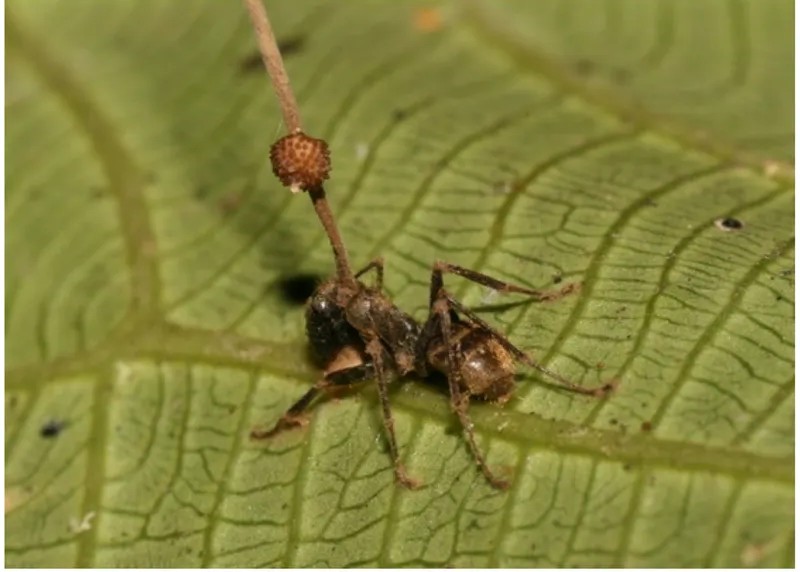
Infected ants don’t just die wherever they happen to be. Ophiocordyceps species drive them to clamp onto vegetation, often a leaf vein or twig, at characteristic heights. After death, a fungal stalk sprouts from the body and releases spores.
The shock lies in the precision. This is not random collapse. The ant ends up fixed in a position that gives the fungus a clean platform for the next round of spread, turning one tiny body into a carefully placed billboard for infection.
2. Entomophthora muscae makes flies summit and freeze
House flies infected with Entomophthora muscae climb upward, cling to an elevated surface, extend a sticky proboscis, and raise their wings. Then they die there.
That final pose matters. It creates an ideal launch point for the fungus’s sticky spores, with the wings lifted out of the way and the body locked in place. What looks like a bizarre insect statue is actually a spore-delivery system.
3. Massospora turns cicadas into hypersexual spore factories
Massospora infections can hollow out cicada abdomens into chalky spore masses. Even more disturbing, these infections are associated with increased mating attempts, helping spread spores through copulatory contact.
The horror is how functional the insect can remain while badly damaged. Instead of simply dropping dead, the cicada becomes a moving dispersal device, carrying an obvious wound that is also the fungus’s transmission engine.
4. Pandora formicae sets ants up for drive-by infection
Pandora formicae pushes infected wood ants to leave the nest, climb low vegetation, and die fixed in place. From there, the fungus ejects spores.
The placement is the trick. The dead ant becomes a roadside turret aimed at passing trailmates below, so spores can strike insects moving along normal colony routes. It is less about distance and more about deadly positioning.
5. Strongwellsea keeps flies airborne while releasing spores
Some Strongwellsea species take a more extreme route. They keep infected flies active while carving an abdominal hole that releases spores during flight.
That means the host is not just a corpse on display. It is a live transmitter. The fungus appears to preserve movement long enough to turn the fly itself into a dispersal machine, even as the body is being consumed.
6. Eryniopsis lampyridarum uses fake sexual signals
This entomophthoralean fungus manipulates soldier beetles so infected individuals mimic a receptive posture on flowers. That posture can lure mates and boost spore transfer during attempted mating.
The unsettling part is the social deception. The fungus is not only changing where the beetle sits but also apparently exploiting the insect’s courtship cues, using sex itself as the delivery route.
Taken together, these six fungi show that there is no single zombie-fungus method. Some target posture, some movement, some contact, and some involve extreme body remodeling, but all of them turn insect behavior into fungal strategy.
Did You Know?
Ophiocordyceps-inspired “zombie ant” fungi are often cited as an example of the “extended phenotype,” because the parasite’s effects can be seen as genes expressed through the host’s altered behavior.