
🚀 Whispers from the silent cosmos
A Star's Slight Wobble Helped Identify a Super-Jupiter
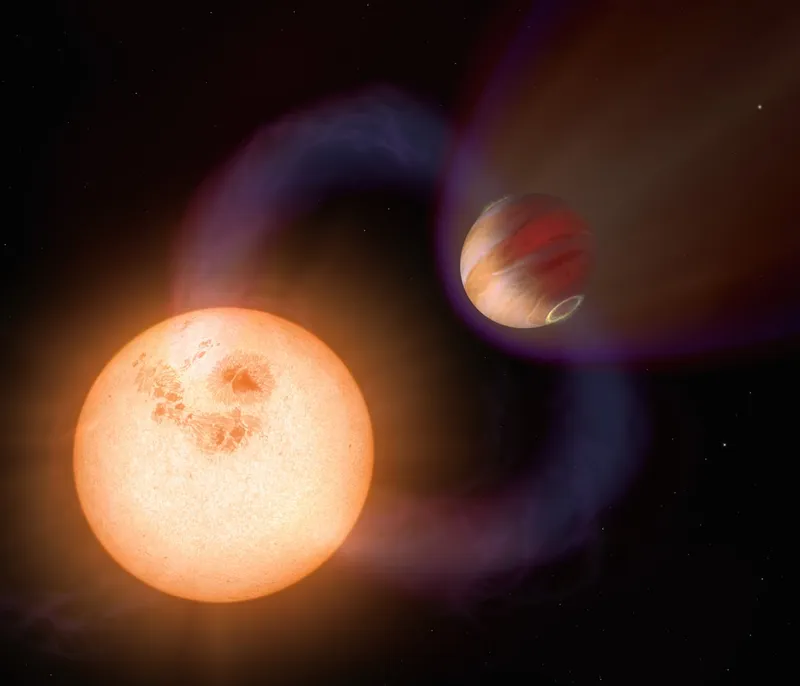
- What: HD 10697 (109 Piscium) was found to have a hidden companion whose mass is estimated at about six times Jupiter’s, inferred from the star’s slight wobble rather than direct imaging.
- Where: About 108 light-years from Earth, in the constellation Pisces.
- When: Using archived astrometric data.
HD 10697, also known as 109 Piscium, is about 108 light-years from Earth. No one needed a direct image of its companion to tell that something large was in orbit. The key clue was a small shift in the star itself.
Astrometry Reveals a Wobble
That kind of measurement comes from astrometry: tracking a star’s position with enough precision to notice when it does not stay perfectly still. Archived astrometric measurements indicated a slight wobble in HD 10697. By itself, that signal is modest. Combined with other observations, it becomes much more informative, because the star’s motion can help constrain the mass of the unseen object pulling on it.
From Planet to Brown Dwarf
For systems like this, the central question is often not whether a companion exists, but what kind of companion it is. A large planet and a low-mass brown dwarf can produce broadly similar signs if the data are incomplete. Brown dwarfs occupy the range between planets and stars: more massive than ordinary planets, but not massive enough to sustain the hydrogen fusion that defines a true star.
In the case of 109 Piscium, the companion’s mass appears to be about six times that of Jupiter. That estimate places it in giant-planet territory rather than the brown-dwarf category. The distinction matters because mass is one of the main things astronomers use to sort these borderline cases. A companion near that divide can change how the whole system is interpreted, from its likely formation history to how unusual the object really is.
What the Wobble Shows
The common misconception is that exoplanet findings depend mainly on dramatic images. In practice, many of the clearest results come from indirect measurements and careful limits. HD 10697 is a straightforward example. A barely detectable positional wobble, preserved in older astrometric data, helped narrow the hidden companion down to something roughly six times Jupiter’s mass.
That is the hard fact at the center of this system: the planet was not revealed by being seen, but by the measurable way its star failed to hold still.
Did You Know?
Astrometry can also measure a star’s position shift caused by an orbiting companion, which is the same basic idea behind some modern planet-hunting missions.