
🧪 Echoes from the lab
Whale Baleen Can Preserve a Timeline of Ocean Change
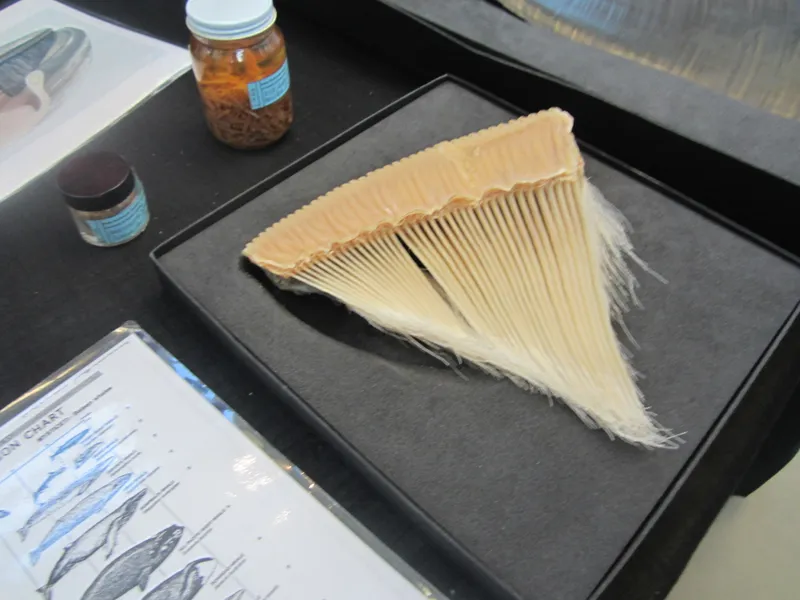
- What: Whale baleen can preserve layered stable-isotope records that let researchers reconstruct diet and feeding changes over time.
- Where: In whale baleen plates and museum-held baleen samples from marine species.
- When: Over years of an animal’s life, including past decades in archived specimens.
Whale baleen is built to strain food from seawater, but it can also preserve a running chemical record of what a whale was eating as the plate grew. Because baleen is made of keratin, the same structural material found in hair and nails, it forms in layers. Those layers can retain stable-isotope signals linked to diet, turning a feeding structure into a biological timeline.
That makes baleen especially useful in species that are hard to observe continuously in the wild. A single plate can hold a long sequence of chemical variation laid down during the animal’s life. In museum collections, older baleen samples extend that value further. Instead of relying only on recent field data, researchers can examine archived material and ask how feeding patterns looked in earlier decades, and in some cases over even longer spans.
Baleen as a chemical archive
The record matters because whale diets are tied to marine food webs shaped by plankton availability and broader ocean conditions. If isotope values shift along the length of a baleen plate, that can point to changes in prey, feeding location, or seasonal behavior. Read carefully, those changes may also help researchers infer shifts in the environment supporting that diet. Baleen does not record the ocean directly, but it captures how a large marine animal moved through those changing conditions over time.
That record is not self-explanatory. Stable-isotope patterns have to be interpreted against whale biology, feeding behavior, and regional ecology, and the signals are not a perfect one-to-one account of past environments. Even so, baleen offers something unusually hard to get in marine science: a continuous archive produced naturally while the animal was alive.
Linking whale diets to ocean change
That is why stored baleen remains scientifically useful long after collection. Archived plates can help connect past and present food webs, especially where direct historical measurements are limited. By comparing isotope records across time, researchers can build a more grounded picture of how whale diets tracked changing plankton systems and how ocean ecosystems have shifted in the process.
Did You Know?
In some baleen whale species, baleen plates can grow to several meters long, which gives scientists a much longer chemical timeline to study than in many other tissues.