
🧪 Echoes from the lab
RNase P Isn't Always an RNA Enzyme
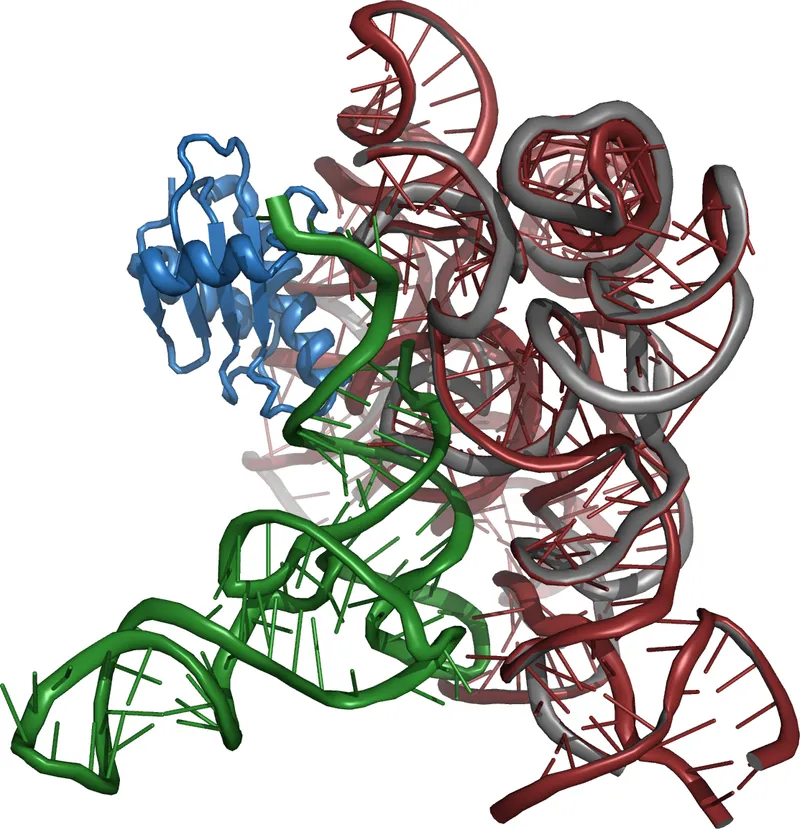
- What: RNase P is usually an RNA-based enzyme, but in some cases—such as human mitochondria and certain plants—it functions as a protein-only enzyme, showing that the same biological job can be done with different molecular machinery.
- Where: Human mitochondria and certain plants.
- When:
RNase P is one of the textbook examples of an RNA-based enzyme. In many organisms, its catalytic core is RNA, with proteins assisting around it. That made it a standard example of the idea that some essential cellular chemistry belongs to RNA as much as to proteins.
But that picture is not universal. In human mitochondria, RNase P works without any RNA component at all. Certain plants appear to use a protein-only version as well. The job is the same, but the molecular machinery is different: a role once associated with a ribozyme can, in some settings, be handled entirely by proteins.
That does not mean the classic model was wrong. RNA-based RNase P is still real and widespread. The more useful correction is narrower: the function is conserved, but the architecture is not. Biology often preserves what a system must accomplish while changing the parts that do it.
The protein-only form matters because RNase P is not a minor enzyme. It processes precursor transfer RNAs, a basic step in gene expression. Replacing an RNA catalyst in that pathway is therefore not a trivial variation. It suggests that proteins can take over chemistry that had seemed closely tied to RNA in at least some compartments and lineages.
That shift also helps clear up a common misconception. Finding an RNA enzyme in biology does not mean that RNA is uniquely required for that reaction everywhere. In this case, evolution appears to have arrived at more than one workable solution. The comparison between RNA-based and protein-only RNase P offers a concrete way to study how the same biochemical task can be rebuilt with different molecular tools.
For researchers, the implication is practical as much as conceptual. If enzyme function cannot be inferred from a familiar name alone, then cell biology has to be read with closer attention to context, including which organism and which organelle is involved. RNase P is still a landmark enzyme. It is just less uniform, and more adaptable, than the standard shorthand suggests.
Did You Know?
RNase P was one of the first RNA enzymes to help support the idea that RNA can act as a catalyst, not just as a carrier of genetic information.