
🧪 Echoes from the lab
How Preserved Specimens Confirmed That Coelacanths Give Live Birth
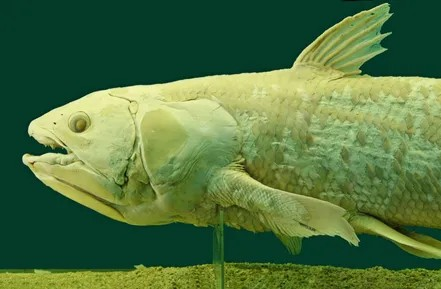
- What: Scientists confirmed that modern coelacanths give live birth by finding preserved females carrying developing embryos inside their bodies, showing ovoviviparity.
- Where: Deep-sea habitats near the Comoros and the coast of southern Africa.
- When: Modern species, based on preserved specimens studied by researchers.
Scientists did not confirm live birth in coelacanths by watching it happen in the wild. They confirmed it by examining preserved females that still held developing young inside their bodies.
Preserved Females With Embryos
That evidence mattered because coelacanths are rarely seen alive and even more rarely encountered in any reproductive state. In the clearest documented cases, preserved specimens of Latimeria contained advanced embryos, each with a large yolk sac. The young had not been released as eggs into the water. They were developing internally and retained by the mother until a late stage, which confirms ovoviviparity: the eggs develop inside the mother, and the offspring are born live.
Researchers had suspected that coelacanths reproduced this way before. Earlier anatomical work and other specimens pointed in that direction. But a pregnant female carrying well-developed pups is different from an inference. It is direct physical evidence from the animal itself.
Why the Evidence Matters
That distinction is more useful than the usual language about coelacanths as ancient survivors. Their lineage is old, but the reproductive question is a modern biological one: how does a deep-sea fish with rare encounters and an apparently slow life history actually produce offspring? Internal development helps answer part of that. It fits a species that seems hard to study, slow to grow, and unlikely to reproduce often.
Some research has also suggested that coelacanth pregnancies may last for years, possibly placing them among the longest known in vertebrates, though that remains difficult to study because sightings are rare and available specimens are limited. Much of what scientists know comes from unusual finds rather than routine observation.
That is part of why the confirmation is so striking. It did not come from a dramatic field observation but from careful study of preserved material from a fish most people know mainly through its fossil history and rare modern catches near places such as the Comoros and the coast of southern Africa.
The key fact is straightforward: modern coelacanths have been found pregnant with developing pups inside the mother, confirming live birth through ovoviviparity.
Did You Know?
Coelacanths are lobe-finned fish, a group more closely related to land vertebrates than to most familiar ray-finned fish.