
🚀 Whispers from the silent cosmos
Karl Jansky and the Radio Noise That Changed Astronomy
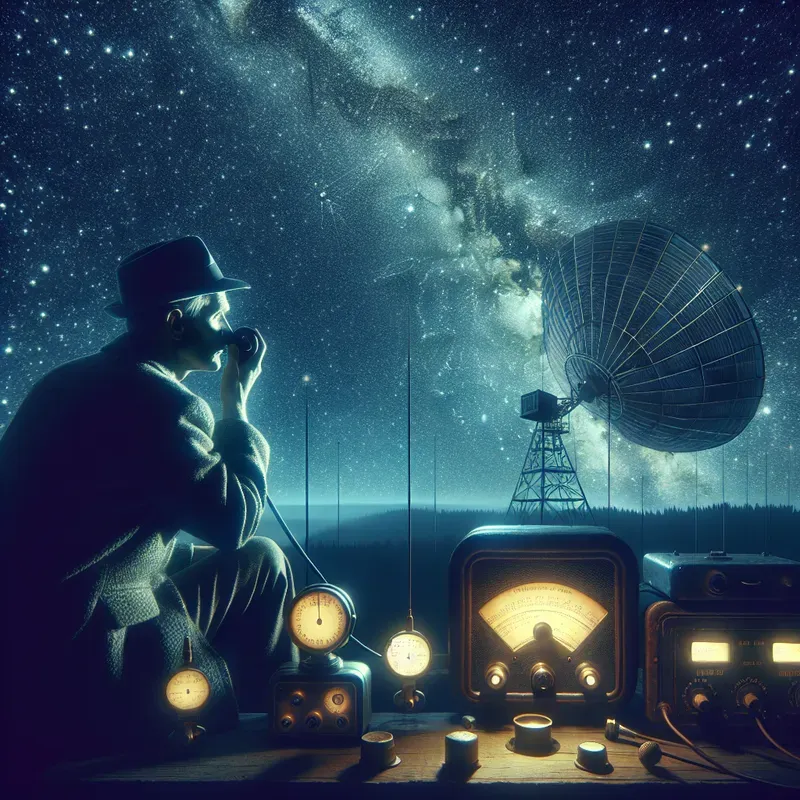
- What: Karl Jansky’s investigation of radio static in the early 1930s revealed radio noise coming from the Milky Way, helping launch radio astronomy.
- Where: Bell Telephone Laboratories in New Jersey.
- When: Early 1930s, with the conclusion reached by 1933.
At first, it looked like a problem. In the early 1930s at Bell Telephone Laboratories in New Jersey, Karl Jansky was trying to track down sources of static that could interfere with transatlantic radio communication. Instead of finding only local storms and nearby electrical noise, he found something stranger: a steady hiss that seemed to come from beyond Earth.
Tracking the Source of Static
The odd signal did not behave like ordinary interference. Jansky built a rotating antenna to study it, a large directional array mounted on wheels and often called his merry-go-round. As he logged the noise, a pattern emerged. One source of static rose and fell on a cycle slightly shorter than a solar day. That pointed away from weather, factories, or power lines. It matched the stars.
By 1933, Jansky had concluded that part of the radio noise was coming from the Milky Way, strongest toward the center of our galaxy in the direction of Sagittarius. Today that sounds like the opening scene of radio astronomy. At the time, though, Bell Labs had hired him to solve a communications problem, not to create a new branch of science. From the company’s point of view, the mystery had been identified, and other work was waiting.
Why Radio Astronomy Waited
That is the part often misunderstood. Jansky was not a lone prophet dramatically ignored while everyone else missed the obvious. His discovery was recognized as interesting, and it was reported publicly. But it sat awkwardly between fields. For engineers, it was no longer the main problem. For astronomers, the tools and habits of observing the sky were still mostly optical. The result was not a grand rejection so much as a quiet mismatch between institutions and timing.
From Bell Labs to Astronomy
Bell Labs reassigned Jansky, and he did not go on to build the field himself. Radio astronomy developed later, especially after others such as Grote Reber began systematic follow-up work. Still, the concrete implication is hard to miss: one of the 20th century’s new ways of observing the universe began as an effort to remove static from phone service. A signal first filed as interference became evidence that the galaxy was talking in a wavelength few people had thought to hear.
Did You Know?
Karl Jansky’s antenna was nicknamed “Jansky’s merry-go-round” because it was mounted on wheels and could rotate to track the signal.