
🧪 Echoes from the lab
LIGO Detector Noise Includes Distant Ocean Wave Vibrations
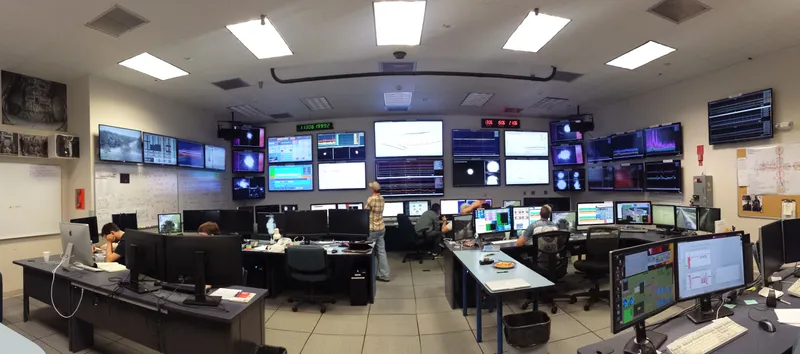
- What: LIGO’s detectors must account for Earth’s own low-frequency vibrations, especially microseisms from ocean waves, when searching for gravitational-wave signals.
- Where: The LIGO observatories in Hanford, Washington, and Livingston, Louisiana.
- When:
LIGO is built to detect gravitational waves, but one of the first things its researchers have to deal with is Earth itself. The twin observatories in Hanford, Washington, and Livingston, Louisiana, are so sensitive that vibrations linked to distant ocean swells can show up in the data as microseisms.
What Microseisms Are
That may sound counterintuitive at first. Gravitational waves come from extreme cosmic events such as merging black holes and neutron stars, so it is easy to assume the hardest part is looking outward into space. In practice, a major part of the job is looking inward at the ground, the air, and the instrument. If the planet is moving even slightly, the detector notices.
Microseisms are low-frequency ground vibrations generated when ocean waves interact, especially during strong swells and storms. Those waves can transfer energy into the seafloor and then through Earth as seismic motion. By the time that motion reaches a detector site inland, it is weak, but LIGO operates at a level where weak still matters.
How LIGO Filters Noise
This does not mean ocean waves are constantly fooling scientists into thinking they found a black hole merger. That is the misconception. Gravitational-wave searches do not rely on a single unexplained wiggle. Researchers build detailed noise models, track environmental sensors, and filter or subtract known sources of disturbance. They also compare signals between the two LIGO sites and, when available, other observatories such as Virgo in Europe and KAGRA in Japan.
A useful example is bad ocean weather. When large swells form far away, the background seismic noise can rise at frequencies that matter for detector stability and sensitivity. Teams monitor these patterns because they can limit how cleanly the instrument performs, especially at the low-frequency end. In other words, a storm at sea can indirectly shape how well a machine in the United States listens for spacetime ripples from billions of light-years away.
Why Ocean Waves Matter
That balance is part of what makes LIGO technically interesting. It is not just a telescope for violent cosmic events. It is also a measurement system that must continuously account for ordinary physical processes on Earth. The practical implication is straightforward: before researchers can claim a signal from deep space, they have to show they understand the quieter, closer motions coming from this planet first.
Did You Know?
The two LIGO observatories are separated by about 3,000 kilometers, which helps scientists compare signals and reject local noise.