
🏺 Recovered from the dusty archives
6 Emergency Currencies Made From Cards, Stamps, and Cigarettes
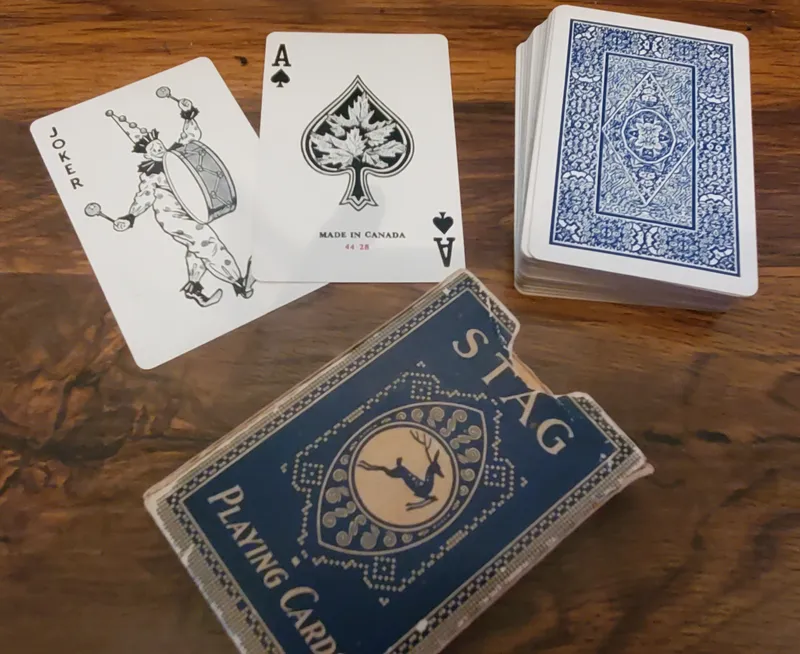
- What: This article explains how societies have used emergency or substitute forms of money when official currency was scarce, disrupted, or mistrusted.
- Where: Various regions in North America, Europe, and Inner Asia.
- When: From the late 17th century to the mid-20th century, especially during war, inflation, and coin shortages.
Money does not always look like coins and banknotes. In moments of war, shortage, and broken trust, people have accepted whatever could keep daily exchange going.
These six documented cases show how emergency currency appeared in specific places and crises: playing cards in New France, artistic notgeld in Germany and Austria, cigarettes in camps and occupied cities, stamp scrip, tea bricks, and even tram tokens used as local change.
1. Playing Card Money of New France
In New France from 1685, officials faced a hard problem: not enough coin. Their answer was startlingly literal. Administrators issued signed playing cards as promissory notes, and those cards were spent in shops and used to pay soldiers.
Why did anyone accept a playing card as money? Because it was backed by authority. The cards were promised for redemption by the colonial treasury, which turned an ordinary object into something people could trust in daily trade.
2. Notgeld: Artistic Emergency Notes in Germany
From 1914 into the early 1920s, towns and firms in Germany and Austria began issuing notgeld, or emergency money, as official small change broke down during wartime disruption and hyperinflation. These notes appeared on paper, cardboard, and even postcards.
The surprise is not just that they circulated, but how local and visual they became. Many were accepted for everyday purchases because communities needed a working substitute right then. Later, their striking designs made them collector favorites, but they began as a crisis tool.
3. Cigarettes as Currency in WWII POW Camps and Occupied Germany
In WWII POW camps, and later in occupied Germany from 1945 to 1948, cigarettes became a de facto currency. People traded individual cigarettes and packs as if they were money, using them to price goods and settle exchanges.
This worked because cigarettes had the qualities money needs in a disrupted economy: they were divisible, standardized, and widely desired. In other words, people accepted them not because a state ordered it, but because nearly everyone recognized their value immediately.
4. Postage-Stamp Money in WWI Central Europe
During the 1914 to 1915 small-change shortage in Austria-Hungary and Germany, municipalities improvised with postage-stamp money. Stamps were affixed to cards or encased, and then circulated as emergency scrip.
It sounds fragile and temporary, and that was the point. These pieces stood in for missing coins, and shops accepted them at face value because communities needed usable change for ordinary transactions.
5. Tea-Brick Currency on Inner-Asian Trade Routes
Across Tibet, Mongolia, and Siberia into the early 20th century, compressed tea bricks circulated as payment. This was not novelty money. On trade routes where coin could be scarce, tea bricks functioned as a practical medium of exchange.
People trusted them because they were durable, divisible, and consumable. If needed, the “money” could literally be used as tea. That intrinsic value helped support acceptance where official coin was limited.
6. Streetcar Emergency Tokens as Local Change
Around 1921, amid coin shortages, some municipal tramways, including Nürnberg–Fürth, issued fare tokens that worked as small-change notgeld. Conductors gave them out as change, and they circulated locally.
That is what makes them so memorable: a transit token crossing into the role of everyday money. In a shortage, the line between ticket and currency could blur quickly if enough people accepted the same substitute.
All six cases show the same pattern. When official money was scarce, delayed, or unstable, people used objects that were trusted, redeemable, useful, or simply familiar enough to keep exchange alive.
Did You Know?
In economics, cigarettes in WWII POW camps became so widely studied that they were used by R. A. Radford in a famous 1945 article explaining how money and prices can emerge inside a barter economy.