
🧪 Echoes from the lab
5 Fossils That Preserve Ancient Moments of Behavior
- What: The article explains how certain fossils preserve behavior in action—such as movement, feeding, and parental care—rather than only an organism’s body shape.
- Where: Ancient terrestrial and marine environments preserved in the fossil record.
- When: Prehistoric life across deep geological time.
Most fossils show what an organism looked like. The rare ones show what it was doing.
That is what makes trace fossils, coprolites, and amber inclusions so gripping in science: they can preserve movement, feeding, mating, or brooding in a single frozen act. Instead of a body alone, they capture a moment.
1. Dinosaur trackways capturing a burst of speed
Some dinosaur trackways preserve a sequence of footprints so clearly that paleontologists can estimate speed and changes in gait from a short run. The spacing, depth, and rhythm of the prints all matter.
That turns a fossil site into something close to a motion record. It is not just a dinosaur foot. It is evidence that, over a brief stretch of ground, the animal changed how it moved.
2. Coprolites with undigested prey and pollen
Coprolites, or fossil droppings, can retain direct traces of a specific meal. In some cases, they preserve plant pollen, insect parts, and fish scales that passed through the digestive system.
That makes them unusually personal fossils. Instead of broad guesses about diet based on teeth or jaws, they can reveal what one animal actually consumed at one moment in ancient time.
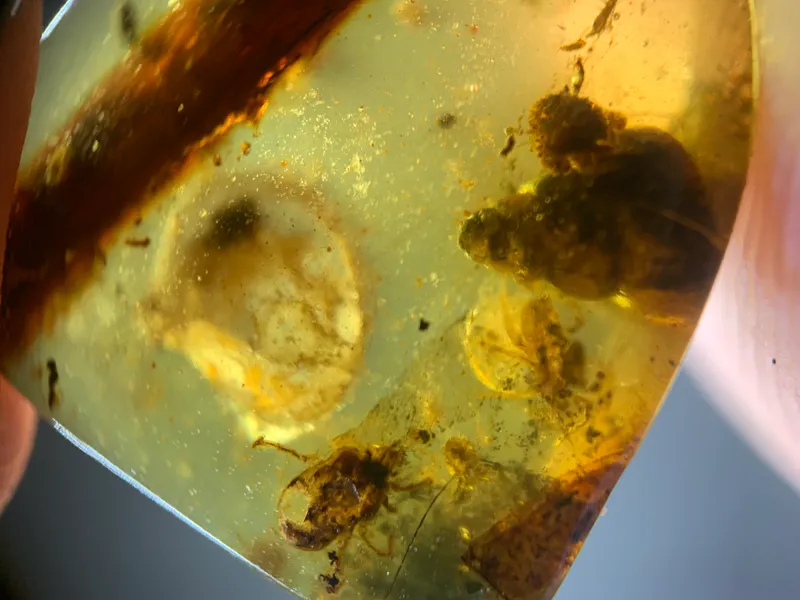
3. Amber trapping mid-action behaviors
Amber is fossilized tree resin, and it can preserve tiny organisms in three dimensions with extraordinary detail. Some inclusions appear to capture clutching, mating, or feeding postures as the resin flowed and hardened.
This is where fossils feel almost uncomfortably immediate. The value is not just in the anatomy. It is behavior caught mid-action, down to body position and contact, preserving a scene instead of a skeleton.
4. Brooding crustaceans preserved with egg clutches
Some fossil crustaceans have been found carrying egg clutches under the abdomen. That is direct evidence of brooding behavior and parental care in ancient lineages.
The surprise is how familiar the behavior feels. Across immense spans of time, the fossil still records a living strategy: protecting developing young rather than simply leaving eggs behind.
5. Trace fossils that record feeding paths
Not all important fossils are bodies. Feeding traces such as burrows and scrape marks can fossilize on ancient seafloors, preserving how soft-bodied animals moved through sediment in search of food.
These traces map behavior that would otherwise vanish completely. They show where an animal probed, grazed, or tunneled, reconstructing a feeding pattern from a surface that became stone.
Taken together, these fossils do something body fossils often cannot: they hold onto a brief act. A run, a meal, a mating posture, a brood, a feeding path. For a moment, ancient life stops seeming static.
Did You Know?
The word “coprolite” comes from Greek words meaning “dung stone.”