
🚀 Whispers from the silent cosmos
Queqiao Relay Satellite Made Chang'e 4 Far-Side Landing Possible
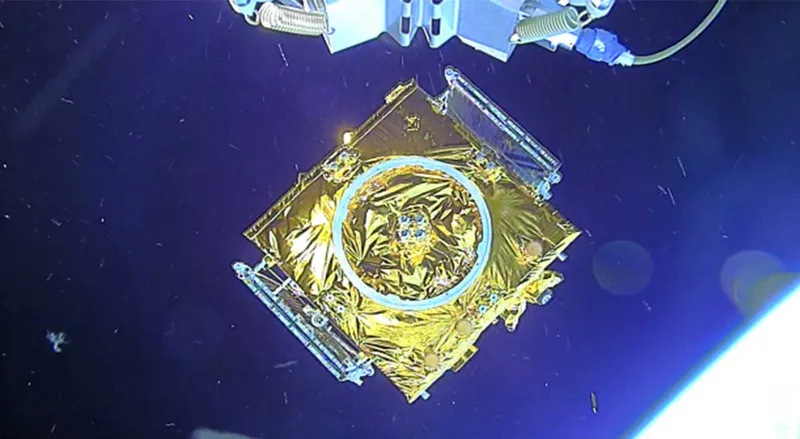
- What: China’s Chang’e 4 mission used the Queqiao relay satellite to maintain communications with the Moon’s far side during its landing and rover operations.
- Where: Moon’s far side, with Queqiao positioned in the Earth-Moon L2 region/halo orbit.
- When: Queqiao was launched in May 2018, and Chang’e 4 reached the far side in January 2019.
China’s Chang’e 4 mission reached the Moon’s far side in January 2019, but the landing depended on something launched months earlier: a relay satellite named Queqiao. Without it, the lander and rover would have disappeared behind the Moon with no direct radio link to Earth.
That was the basic problem from the start. The Moon always keeps the same face roughly toward Earth, so the far side is permanently out of direct view. A spacecraft landing there cannot simply phone home. For Chang’e 4, China solved that communications gap before the landing even happened.
Queqiao Orbit and Role
In May 2018, Queqiao was sent toward the Earth-Moon L2 region, a point beyond the Moon on the far-side line. It did not sit exactly on a mathematical point like a marker pinned in space. Instead, it entered a halo orbit around the Moon-Earth L2 area, where it could maintain line of sight to both Earth and the spacecraft operating on the lunar far side.
That placement was key. The lander and the Yutu-2 rover could send data to Queqiao, and Queqiao could relay that data back to Earth. Commands could also go the other way. The result was continuous communications support for a mission that otherwise would have been cut off whenever it operated where Earth could not see it.
Why Chang’e 4 Needed It
The landing itself happened in Von Kármán crater, inside the South Pole-Aitken Basin, one of the Moon’s most scientifically important regions. But the mission’s most interesting engineering move was arguably not the touchdown. It was the decision to treat communications as the first obstacle, not the last detail.
That has a broader consequence for lunar exploration. Reaching the far side is not just about propulsion, navigation, or landing safely. It also requires infrastructure in the right place. Queqiao turned a hidden hemisphere into an accessible operating zone.
Future Far-Side Mission Infrastructure
In concrete terms, that means future far-side missions do not begin with the lander. They begin with the relay network. Chang’e 4 showed that if you want to work on the part of the Moon Earth cannot see, the first spacecraft may need to be the one that waits overhead and keeps the connection alive.
Did You Know?
Queqiao also carried the Netherlands-China Low-Frequency Explorer (NCLE), an instrument designed to study cosmic radio signals from the early universe.