
🚀 Whispers from the silent cosmos
Bennu Rock Ejections Show Asteroids Aren't Geologically Still
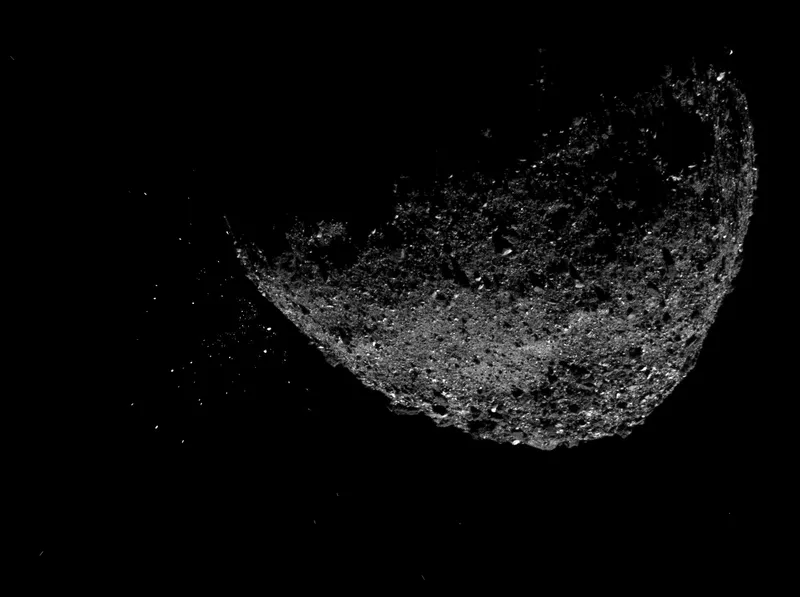
- What: OSIRIS-REx observed asteroid Bennu ejecting small rocks and dust from its surface, showing the rubble-pile asteroid is more active than expected.
- Where: At asteroid Bennu, a near-Earth asteroid in space.
- When: After OSIRIS-REx arrived at Bennu in 2018.
NASA’s OSIRIS-REx spacecraft saw asteroid Bennu do something many people did not expect: it spit small rocks into space. The observation, made after the spacecraft arrived at Bennu in 2018, showed that this small near-Earth asteroid was not just a quiet pile of debris drifting around the Sun.
Bennu Rock Ejection Events
The surprise came when OSIRIS-REx cameras caught particles leaving Bennu’s surface in multiple ejection events. Some escaped into space. Some briefly orbited the asteroid. Others fell back down. These were not giant explosions, but they were real, measurable releases of material from an object only about 500 meters wide.
That mattered because Bennu is a rubble-pile asteroid, meaning it is not one solid rock. It is a loose collection of broken material held together mainly by gravity. Before close-up observations, it was easy to picture a body like that as inert unless struck by something. Bennu showed otherwise. Even a small rubble pile can have active surface processes.
What Causes Bennu to Shed Rocks
Scientists considered several explanations for the rock ejections, including meteoroid impacts, release of volatile material, and thermal fracturing. Thermal fracturing became an important part of the picture: Bennu rotates every 4.3 hours, so its surface swings through large temperature changes as sunlight comes and goes. Over time, that repeated heating and cooling can crack rocks, weaken the surface, and help free particles.
The key misconception Bennu helped correct is the idea that “small asteroid” means “dead asteroid.” Bennu is not a miniature planet with volcanoes or weather, and the spacecraft did not find anything supernatural or biological. But it also was not motionless. Its surface was changing in ways that could be directly observed.
Why Bennu’s Activity Matters
That has practical consequences. If small asteroids can naturally shed material, then their surfaces, hazards, and histories are more dynamic than they may look from far away. For spacecraft missions, sampling plans and navigation have to account for that. For planetary science, Bennu became a reminder that even a loose, modest-sized body can keep reshaping itself in space, one small burst of rock at a time.
Did You Know?
OSIRIS-REx later collected a sample from Bennu and returned it to Earth in 2023.