
🌿 Stories carved by wind and water
Kawah Ijen Sulfur Miners and the Blue Fire
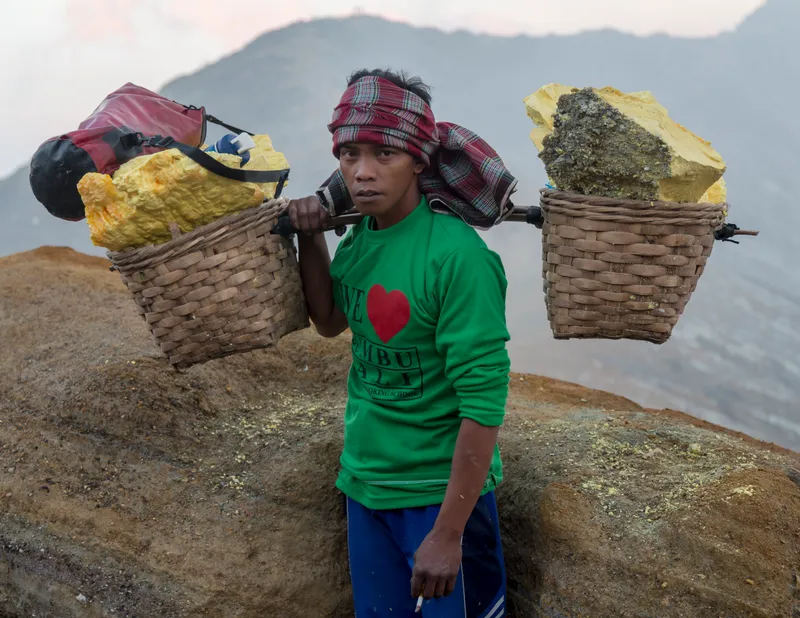
- What: The article explains how Kawah Ijen’s blue sulfur flames form and how miners work in dangerous conditions extracting sulfur from the crater.
- Where: Kawah Ijen volcano in East Java, Indonesia.
- When: Mostly before sunrise and at night, when the blue flames are visible and miners work in the crater.
Before sunrise at Kawah Ijen in East Java, Indonesia, the crater glows with an electric blue fire. In the same darkness, sulfur miners move through toxic fumes, climbing the volcano with loads that can weigh roughly 70 to 90 kilograms.
How the Blue Fire Forms
The blue flames are what most visitors notice first. They appear when sulfuric gases escape through cracks in the volcano, ignite, and burn blue at night. As the gases cool, they condense into bright yellow sulfur around the vents. That is the material miners collect by hand.
If the wind shifts, the work changes instantly. Thick gas can sweep across the path, forcing miners to cover their faces and keep moving through air that can sting the eyes and lungs. Then comes the hardest part: breaking up solid sulfur near the crater, loading it into baskets, and hauling it up the steep rim before carrying it farther downhill. The route is uneven, dark, and physically punishing even without the fumes.
Dangers of Sulfur Mining
Kawah Ijen is unusual because the volcanic spectacle and the labor are inseparable. The same underground system that creates the famous blue fire also produces the sulfur that supports this dangerous work. Tourists often arrive for a rare natural phenomenon. Nearby, miners make repeated trips through the same crater as part of a routine shift.
That contrast matters because it changes what the blue fire really represents. It is not only a striking volcanic event. It is also evidence of an active sulfur deposit that people still extract under harsh conditions. The danger is not abstract. It is built into the chemistry of the place: hot gas, unstable footing, heavy loads, and repeated exposure during the night.
What the Blue Fire Reveals
By daylight, the crater lake and yellow sulfur deposits are easier to see, and the blue flames usually fade from view. But the night work leaves a clear physical fact behind. Every basket of sulfur that reaches the rim has already passed through a crater filled with acidic gas, and each load reflects the cost of turning a volcanic process into manual labor.
Did You Know?
Kawah Ijen is also known for being one of the few places on Earth where “blue fire” can be seen from burning sulfur gas.