
🧩 Fragments from the unknown
Somerton Man Tamám Shud Scrap Changed the Case
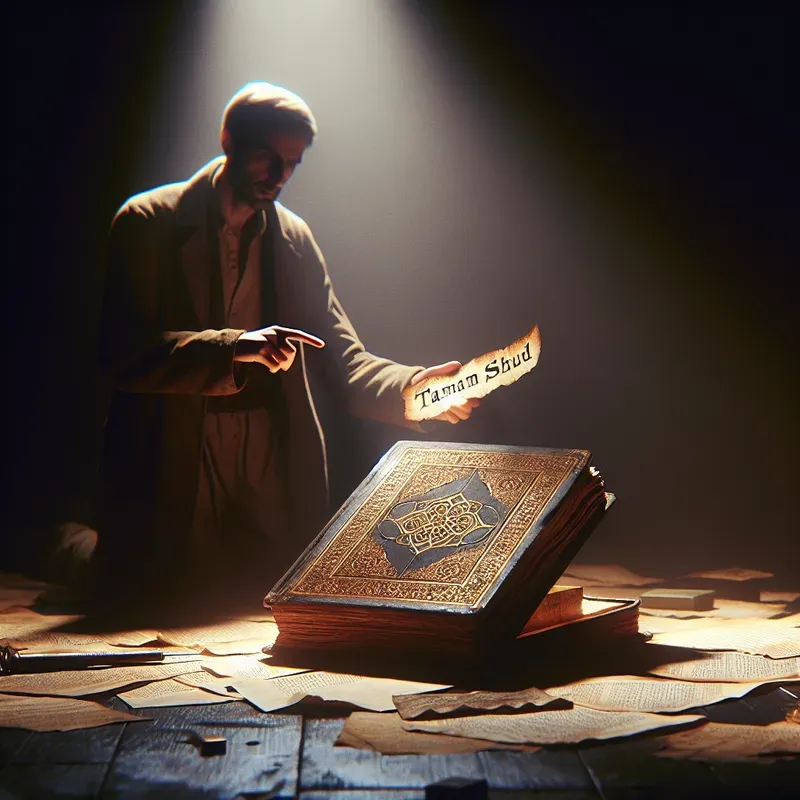
- What: The Somerton Man case became especially famous after police found a tiny paper scrap reading “Tamám Shud,” which led them to a copy of the Rubáiyát of Omar Khayyám and possible coded writing inside it.
- Where: Somerton Beach in Adelaide, South Australia.
- When: December 1948.
The Somerton Man case did not turn sharply because of a body. It turned because of a tiny scrap of paper.
Tamám Shud Paper Fragment
In December 1948, an unidentified man was found dead on Somerton Beach in Adelaide, South Australia. He had no clear identification. Then investigators found something unusual hidden in a small fob pocket in his trousers: a narrow piece of paper printed with the words Tamám Shud, a Persian phrase often translated as ended or finished.
That fragment mattered because it was not just a strange message. Police later linked it to a missing piece torn from a copy of the Rubáiyát of Omar Khayyám. The book was reportedly found after a man said he had discovered it in his car around the time of the death. Inside that copy, the final page had been torn out. The torn edge allegedly matched the scrap found on the dead man.
Rubáiyát Book and Code
That discovery changed the shape of the mystery. Up to that point, the case looked mainly like an identification problem: who was this man, and why could no one name him? Once the Rubáiyát appeared, attention widened. Investigators now had an object connected to the body, a missing page, and another detail that drew even more notice: pencilled letters in the back of the book that some believed might be a code.
The writing has not been definitively solved, and there is no definitive proof it was a meaningful cipher at all. It may have been a personal note, random lettering, or something more structured. But its presence was enough to redirect the case. The mystery was no longer only about a nameless man on a beach. It became a question of whether he had been carrying, or receiving, some kind of concealed message.
Why the Scrap Changed the Case
That shift had consequences. It pulled the Somerton Man case into a different category of public fascination, where forensic identification sat beside cryptic communication. The hidden scrap made the death seem more deliberate. The book made it seem connected. And the pencilled letters kept alive the possibility that the case involved private signals no one could fully read.
Decades later, even with renewed interest in the man’s identity, that small piece of paper still sits at the center of the story. It did not explain who he was. It only made the mystery larger.
Did You Know?
The phrase “Tamám Shud” comes from Persian and is commonly translated as “ended” or “finished.”