
🧩 Fragments from the unknown
Qing Imperial Consort Robe Preserves Exact Qianlong 43 Receipt Tag
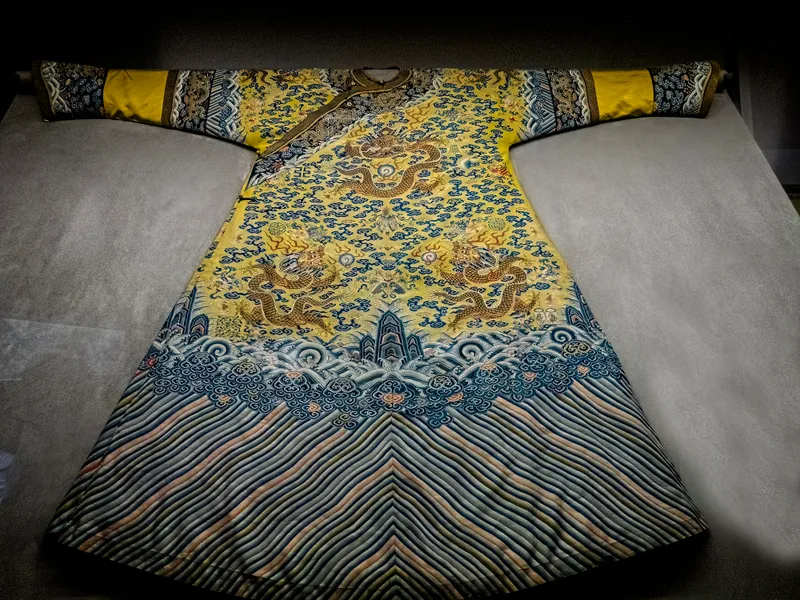
- What: A Qing imperial consort’s robe survives with its original yellow tag, which records the fabric and the exact date it was received in the palace.
- Where: The Qing imperial court in China.
- When: Qianlong reign year 43.
A Qing imperial consort’s robe survives with something even rarer than its embroidery: the original yellow tag that recorded its fabric and the exact date it was received in the palace. The tag states the receipt date as the 28th day of the 11th month in the 43rd year of the Qianlong reign.
That detail changes how the robe is understood. Without the tag, it would still be an important Qing court garment, identifiable by material, color, and rank-related design features. With the tag still attached, it becomes a dated administrative record as well as a textile object. It is not just a robe from the Qianlong period. It is a robe documented to a specific day within that period.
Yellow Tag and Receipt Date
The yellow tag matters because palace textiles were part of a tightly organized system of production, allocation, and storage. A surviving label can preserve information that scholars usually have to reconstruct from archives, comparison, or technical analysis. Here, the object carries its own paperwork. The tag records what the fabric was and when the robe was received, linking the physical garment directly to court management practices inside the Qing imperial system.
That kind of survival is unusual. Clothing is fragile to begin with. Tags are even more vulnerable. They are easily torn off, replaced, lost, or separated from the object over time. In many historical garments, provenance becomes less precise with each generation of handling. This robe avoids that problem in a striking way: the dating evidence remains physically attached.
Why the Tag Matters
The result is a different kind of certainty. Museums and historians often work in ranges, probabilities, and stylistic attribution. This robe still allows those methods, but it also offers a fixed point. The yellow tag narrows the gap between art history and record keeping.
In hard factual terms, the surviving tag records the robe’s fabric and gives a receipt date of the 28th day of the 11th month of Qianlong year 43, placing this imperial consort’s robe in that year with unusual precision.
Did You Know?
The tag makes the robe not just a garment but a primary source for palace inventory and administration.