
🚀 Whispers from the silent cosmos
Crab Pulsar Signals Shifted by Tiny Plasma Filaments
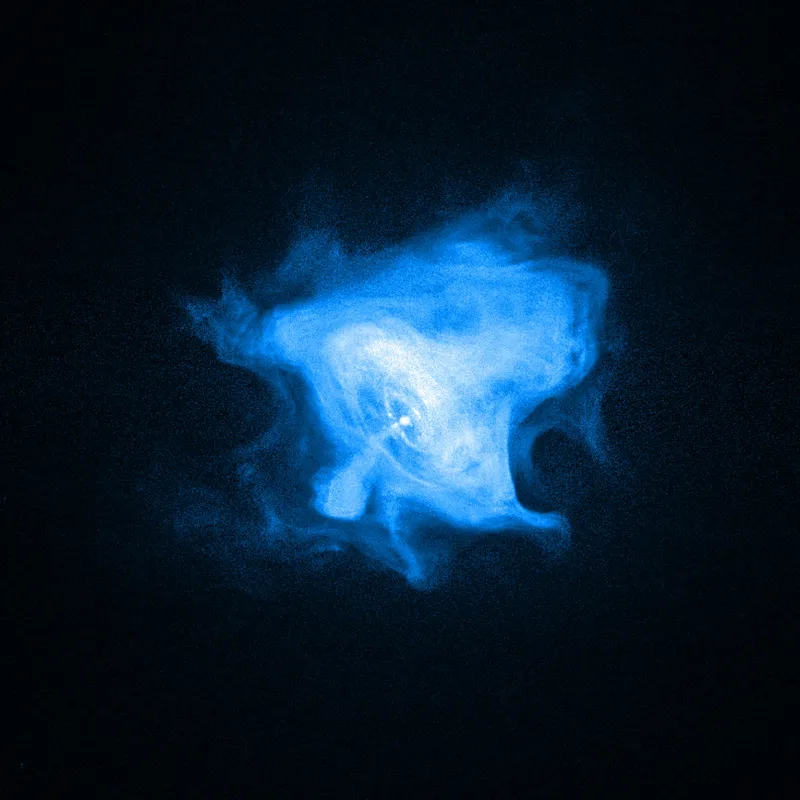
- What: Astronomers observed that radio pulses from the Crab pulsar were briefly delayed and echoed because small plasma filaments in the Crab Nebula crossed the line of sight and distorted the signal.
- Where: The Crab Nebula in the constellation Taurus.
- When: The Crab pulsar comes from the supernova remnant of the 1054 event; the delays were seen during recent radio observations.
Astronomers watching the Crab pulsar found that its radio pulses did something unusual: they arrived late, and some were followed by brief extra echoes. The changes did not come from the pulsar itself. They appeared when small plasma filaments inside the Crab Nebula crossed the line of sight between Earth and the pulsar.
Crab Pulsar Radio Delays
The Crab pulsar sits inside the expanding debris of a supernova recorded in 1054, in the constellation Taurus. It is one of the best-studied pulsars in the sky, partly because its radio flashes are so regular. That regularity is what made the disturbance stand out. During these episodes, astronomers could measure extra delay in the pulses and detect short-lived secondary signals, as if the radio waves had been forced onto slightly different paths before reaching telescopes.
The simplest explanation is that compact clumps or filaments of ionized gas in the nebula acted like imperfect lenses. Plasma does not bend radio waves the way ordinary glass bends visible light, but it can still refract and slow them in frequency-dependent ways. When one of these structures drifted across the narrow sightline to the pulsar, it changed both the travel time and the apparent route of the signal. The result was a brief, measurable distortion layered onto an otherwise predictable pulse train.
Plasma Filaments in the Nebula
What makes this notable is the scale. These were not giant, nebula-wide changes. They were tiny structures inside the Crab Nebula, small enough to be easy to miss in direct images, yet still capable of perturbing a precision timing signal from a neutron star. In effect, the pulsar worked like a background probe, revealing fine structure in the intervening plasma that would be hard to map another way.
Why It Matters for Pulsar Timing
That has a broader consequence for radio astronomy. Pulsar timing is often treated as a tool for measuring the pulsar, but events like this show that the material between the source and the observer can leave its own fingerprint. Small plasma clouds can add delays, split paths, and create echoes that matter on observable timescales.
In concrete terms, the Crab system shows that radio signals moving through messy astrophysical environments do not just fade; they can be reshaped in ways astronomers can time and model. A brief shift in a pulse can become evidence for otherwise hidden filaments drifting through a supernova remnant.
Did You Know?
The Crab pulsar is also famous for being bright across radio, optical, and X-ray wavelengths.