⚙️ Traces from the dawn of innovation
7 Embedded Controllers Running Critical Infrastructure Behind the Scenes
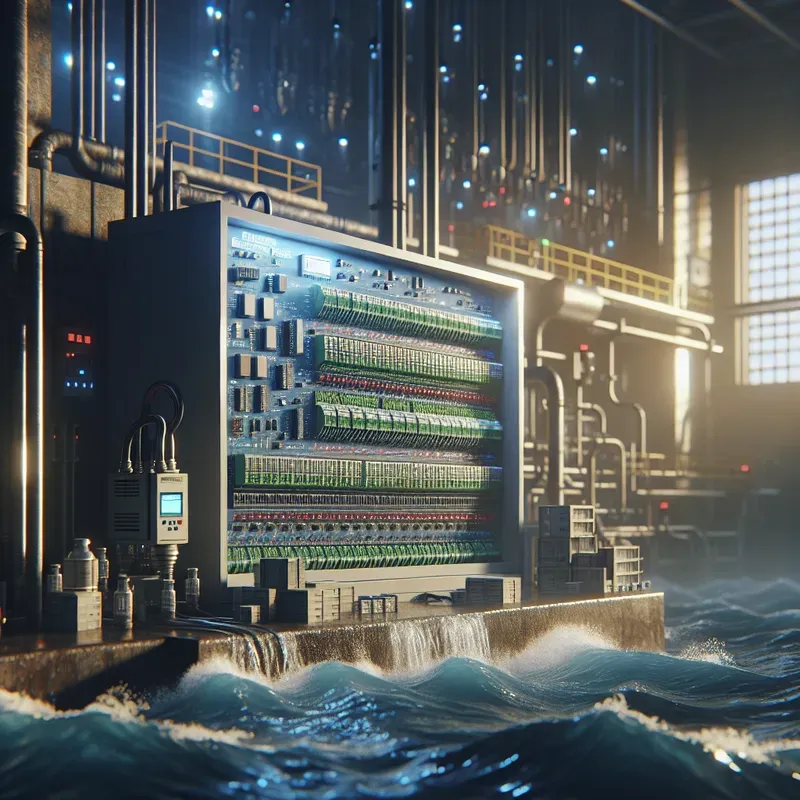
- What: This list explains how small embedded controllers and sensor systems quietly make high-impact operational and safety decisions across critical infrastructure.
- Where: Critical infrastructure environments such as utilities, buildings, transport systems, and public works.
- When: Present-day infrastructure operations.
Critical infrastructure does not depend only on giant machines, control rooms, and visible hardware. In many cases, the decisive logic lives inside small embedded controllers, quietly making choices every second.
These devices sit inside water plants, elevators, roads, rail systems, buildings, and utility networks. They are easy to overlook, but their firmware, timing, and configuration can shape reliability, safety, and daily life at scale.
1. PLC boards in water treatment plants
In water treatment plants, Programmable Logic Controllers coordinate the routines that keep the system moving: pumps turning on, valves opening and closing, chemical dosing, and treatment cycles staying in sequence. The board itself can be compact, but it is effectively directing a plant-wide process.
What makes that surprising is how much leverage sits in that small controller. A bug or misconfiguration is not a minor software issue here; it can alter water chemistry decisions across the facility and affect how the whole plant operates.
2. Building HVAC controllers dictating air flow
Inside air handlers and rooftop units, embedded HVAC controllers handle schedules, ventilation behavior, and setpoints. They help determine when air moves, how much outside air is introduced, and how heating or cooling responds across a building.
That matters because the effect is bigger than comfort. These small controllers can influence indoor air quality, occupant conditions, and energy use at the scale of an office, school, or apartment block, all while remaining almost invisible to the people inside.
3. Elevator microcontrollers managing emergency logic
Elevators feel mechanical, but their behavior during critical moments is governed by compact controllers running safety, door, and emergency recall logic. The firmware decides how the car reacts when faults occur and how it transitions during fire-related scenarios.
The surprising part is that a tiny embedded system is orchestrating what many people assume is purely hardwired machinery. In an emergency, that firmware is not just background code; it is central to how the elevator responds.
4. Traffic signal controllers shaping city flow
At intersections, traffic lights are driven by embedded cabinet controllers that execute timing plans and coordination logic. They determine the rhythm of movement from one junction to the next, especially on busy corridors.
Because of that, small failures or tampering can have outsized effects quickly. A modest controller issue at street level can ripple outward into congestion, delays, and corridor-wide disruption that feels much larger than the hardware causing it.
5. Smart meters with remote disconnect and load limiting
Smart meters are often treated like passive measuring devices, but their embedded logic can do more than report usage. With internal relays, they may remotely connect or disconnect service and enforce load limits.
They can also, through HAN links, signal demand-response devices to shed load during grid stress. That means a small controller on the side of a building can participate in real grid behavior, not just billing or monitoring.
6. Railway axle counters ensuring track vacancy with precise timing
Railway axle counters use precise evaluation electronics to determine whether a section of track is occupied. Their reports feed interlockings that rely on accurate track vacancy information to maintain train separation.
The hidden tension lies in the precision. These trackside embedded systems are small compared with the trains they protect, yet errors in their occupancy reporting can cascade into major operational disruption across the railway.
7. Bridge sensor nodes monitoring fatigue indicators
On bridges, low-power sensor nodes gather vibration and strain data over time. Embedded firmware applies thresholds to spot anomalies or fatigue indicators and trigger alarms that can escalate for inspection.
That is the quiet power of infrastructure monitoring: a tiny node bolted onto a structure can act as an early warning layer. It does not carry the bridge, but it can influence when hidden structural concerns are noticed.
The pattern is easy to miss until you look closely: some of the most consequential decisions in infrastructure are made not by massive machines, but by modest embedded controllers doing narrow jobs with very large consequences.
Did You Know?
The first commercial PLC, the Modicon 084, was introduced around 1968 for industrial automation.