🧪 Echoes from the lab
6 Sensors That Accidentally Made Major Scientific Discoveries
- What: This article highlights how instruments built for practical or unrelated scientific purposes unexpectedly produced major discoveries in astronomy, physics, and Earth science.
- Where: Across observatories, laboratories, satellites, and monitoring networks on Earth and in near-Earth space.
- When: Mainly in the modern scientific era, from the mid-20th century to the present.
Some of the biggest discoveries in science did not begin as discovery missions. They began as maintenance problems, routine measurements, or instruments built for completely different jobs.
These six sensors and detector systems were designed for communications, navigation, particle physics, or Earth monitoring. Instead, they ended up revealing relic radiation, supernova neutrinos, relativity in daily operation, hidden seismic activity, atmospheric wave patterns, and pulsars.
1. Penzias & Wilson’s horn antenna — CMB found while chasing noise
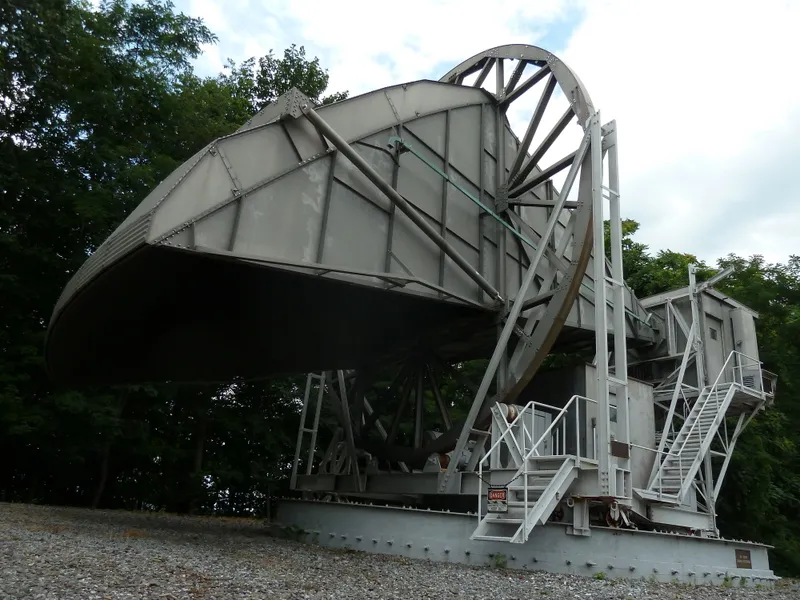
At Bell Labs in 1964, Arno Penzias and Robert Wilson were trying to eliminate a stubborn microwave hiss from a horn antenna built for satellite communications work. The signal would not go away.
That “noise” turned out to be the cosmic microwave background, relic radiation from the early universe. The surprise was huge: during troubleshooting, a communications instrument had measured one of cosmology’s most important signals.
2. Kamiokande — a proton-decay detector that caught a supernova’s neutrinos
Kamiokande was built to look for proton decay, not exploding stars. But when Supernova 1987A occurred, the detector recorded a burst of neutrinos from the stellar collapse.
That mattered because it was the first real-time neutrino observation tied to a supernova core collapse. A detector aimed at one of particle physics’ hardest questions suddenly became a window into a dying star.
3. GPS atomic clocks — navigation that routinely demonstrates relativity
GPS exists to tell people and machines where they are. But the system works accurately only because engineers must correct satellite clock rates for both special- and general-relativistic effects.
That makes GPS an everyday technology with a deep scientific side effect: its normal operation effectively confirms relativistic time shifts with high precision. Navigation hardware became a constant test of Einstein’s ideas in practice.
4. Seismic arrays for nuclear-test monitoring — mapping microquakes and glacial quakes
Seismic arrays were developed in part to detect underground nuclear explosions. To do that job well, they had to become extremely good at sensing subtle ground motion from far away.
That sensitivity also revealed abundant microseismic activity and helped identify remote events such as glacial earthquakes. Systems built for security monitoring ended up enriching global earthquake catalogs and Earth science research.
5. Weather satellites — storm watchers that revealed atmospheric gravity waves
Weather satellites were launched to track clouds, storms, and large-scale atmospheric conditions. Their infrared and visible imagery, along with limb sounding, revealed something broader than forecasting alone.
They exposed widespread atmospheric gravity-wave patterns and global circulation features that had been difficult to see directly on a synoptic scale. The same eyes used for weather suddenly showed the atmosphere’s hidden structure in motion.
6. Cambridge scintillation array — pulsars’ telltale ticks emerge
In 1967, a radio telescope array at Cambridge was being used to study interplanetary scintillation. While examining the data, Jocelyn Bell Burnell and colleagues found signals with strikingly regular pulses.
Those ticks were eventually identified as pulsars, rapidly spinning neutron stars. An array tuned to study radio-source flicker ended up revealing one of astronomy’s most distinctive classes of objects.
What links all six stories is not luck alone. It is that precise instruments, used carefully enough, can turn routine data into evidence of something nobody set out to find.
Did You Know?
The 1978 Nobel Prize in Physics was awarded to Arno Penzias and Robert Wilson for the discovery of the cosmic microwave background.