
🌍 Records from the halls of power
Moscow Metro Stations Built as Transit Hubs and Shelters
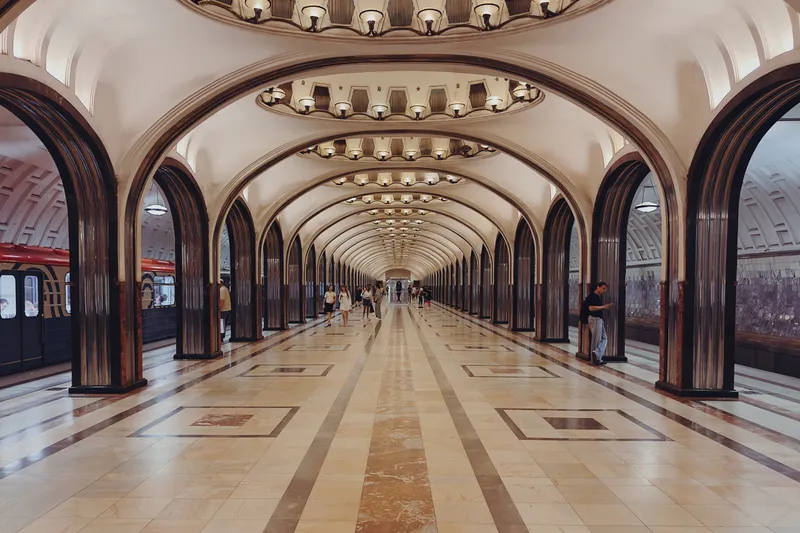
- What: The Moscow Metro was designed not only as a transit system but also as part of Soviet civil defense, with deep stations serving as air-raid shelters during wartime.
- Where: Moscow, Russia
- When: Built from the 1930s and used as shelter during World War II, especially in 1941.
Most subway systems are built to move people quickly. Moscow’s metro was also built to protect them.
Moscow Metro as Civil Defense
That contrast is part of what makes the Moscow Metro so unusual. Beginning in the 1930s, Soviet planners created stations that were not only transport infrastructure but also part of a broader civil defense system. Some of the city’s most famous stops, with chandeliers, marble columns, mosaics, and cavernous halls, were designed deep underground for practical as well as symbolic reasons. They had to function every day as commuter stations, and in an emergency, they could serve as shelters.
The idea came first, then the architecture made it visible. Deep stations offered some protection from air raids, and the metro’s tunnels and platforms could hold large numbers of people. During World War II, that role stopped being theoretical. When German bombing threatened Moscow in 1941, residents used metro stations as air-raid shelters. People slept on platforms, medical posts were set up, and some stations continued operating even while sheltering civilians. The metro was still a transport network, but it had become refuge as well.
Deep Stations and Wartime Shelter
Several stations are especially known for their grand design. Mayakovskaya, opened in 1938, is one of the clearest examples of the “palace for the people” idea: polished metal, bright lighting, and ceiling mosaics in a station built deep below the city. Komsomolskaya, with its sweeping interior and heavy ornament, shows the same logic on a larger scale. These spaces looked ceremonial, but their depth and scale also fit civil-defense planning. Claims about hidden rooms or extensive secret facilities beyond known infrastructure often circulate around the Moscow Metro, but many of those stories remain unconfirmed. What is well established is the dual-use purpose of deep stations and the metro’s wartime shelter function.
Stalin-Era Infrastructure and Design
That combination says something important about the era that built it. In Stalin-era Moscow, infrastructure was expected to do more than one job. The metro had to be efficient, politically impressive, and resilient under attack. Beauty was not treated as separate from utility; in this case, they were built together underground.
The result is unusually concrete. In central Moscow, a commuter could pass under mosaics and chandeliers in a station that was also planned to keep civilians alive during bombing. The same marble hall served two purposes at once: a daily route through the city and a ready-made shelter below it.
Did You Know?
Most subway systems are built to move people quickly. Moscow’s metro was also built to protect them.
Moscow Metro as Civil Defense
That contrast is part of what makes the Moscow Metro so unusual. Beginning in the 1930s, Soviet planners created stations that were not only transport infrastructure but also part of a broader civil defense system. Some of the city’s most famous stops, with chandeliers, marble columns, mosaics, and cavernous halls, were designed deep underground for practical as well as symbolic reasons. They had to function every day as commuter stations, and in an emergency, they could serve as shelters.
The idea came first, then the architecture made it visible. Deep stations offered some protection from air raids, and the metro’s tunnels and platforms could hold large numbers of people. During World War II, that role stopped being theoretical. When German bombing threatened Moscow in 1941, residents used metro stations as air-raid shelters. People slept on platforms, medical posts were set up, and some stations continued operating even while sheltering civilians. The metro was still a transport network, but it had become refuge as well.
Deep Stations and Wartime Shelter
Several stations are especially known for their grand design. Mayakovskaya, opened in 1938, is one of the clearest examples of the “palace for the people” idea: polished metal, bright lighting, and ceiling mosaics in a station built deep below the city. Komsomolskaya, with its sweeping interior and heavy ornament, shows the same logic on a larger scale. These spaces looked ceremonial, but their depth and scale also fit civil-defense planning. Claims about hidden rooms or extensive secret facilities beyond known infrastructure often circulate around the Moscow Metro, but many of those stories remain unconfirmed. What is well established is the dual-use purpose of deep stations and the metro’s wartime shelter function.
Stalin-Era Infrastructure and Design
That combination says something important about the era that built it. In Stalin-era Moscow, infrastructure was expected to do more than one job. The metro had to be efficient, politically impressive, and resilient under attack. Beauty was not treated as separate from utility; in this case, they were built together underground.
The result is unusually concrete. In central Moscow, a commuter could pass under mosaics and chandeliers in a station that was also planned to keep civilians alive during bombing. The same marble hall served two purposes at once: a daily route through the city and a ready-made shelter below it.
VideoScript:Moscow built subway stations that looked like palaces. But that was only half the story.
Some of the metro’s deepest, most ornate stations were also part of civil defense planning. Marble. Chandeliers. Huge halls. And in a crisis, shelter.
During World War II, this stopped being design theory. Muscovites used metro stations as air-raid shelters during bombing raids.
So the reveal is this: those famous Moscow Metro “museums” were never just beautiful transit spaces. They were built to move crowds by day and protect them underground when needed.
Summary:- What: The Moscow Metro was designed not only as a transit system but also as part of Soviet civil defense, with deep stations serving as air-raid shelters during wartime.
- Where: Moscow, Russia
- When: Built from the 1930s and used as shelter during World War II, especially in 1941.
Mayakovskaya station was used as a bomb shelter during the 1941 air raids and briefly hosted a speech by Stalin there during the October Revolution anniversary events in 1941.
