🚀 Whispers from the silent cosmos
New Horizons Carried Clyde Tombaugh's Ashes to Pluto
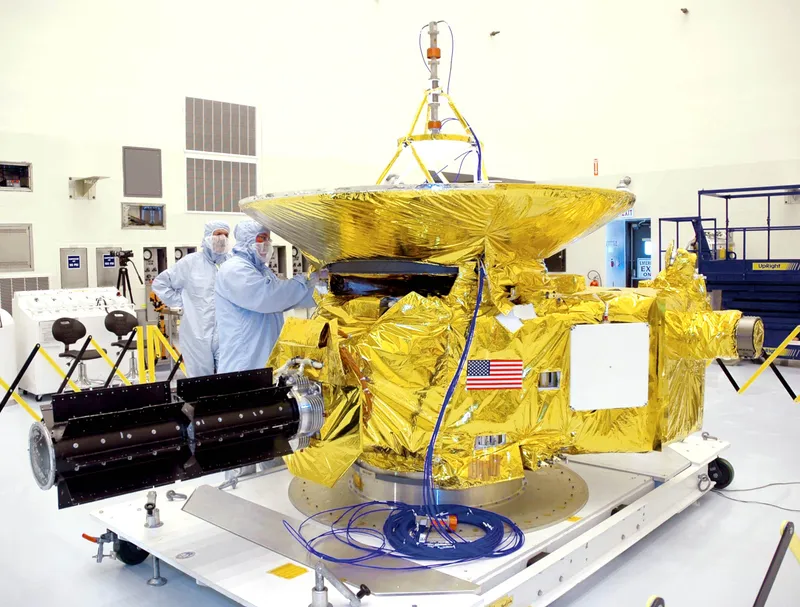
- What: NASA’s New Horizons spacecraft carried a small capsule containing Clyde Tombaugh’s ashes, making its trip to Pluto a symbolic memorial to the astronomer who discovered the dwarf planet.
- Where: Launched from Cape Canaveral, Florida; flew past Pluto and later into the Kuiper Belt.
- When: Launched in January 2006, passed Pluto on July 14, 2015, and flew past Arrokoth in 2019.
When NASA’s New Horizons spacecraft launched in January 2006 from Cape Canaveral, Florida, it was carrying more than cameras, instruments, and flight hardware. Tucked aboard was a small container holding some of Clyde Tombaugh’s ashes, linking the mission directly to the man who discovered Pluto in 1930.
That detail turned an already historic planetary mission into something more specific: a literal memorial journey. New Horizons flew past Pluto on July 14, 2015, delivering the first close-up views of the dwarf planet and its moons. The ashes added no scientific function, but symbolically, they connected the spacecraft’s destination to the astronomer whose work put Pluto on the map in the first place.
Clyde Tombaugh and Pluto
Tombaugh discovered Pluto while working at Lowell Observatory in Arizona, after a long photographic search for what was then called Planet X. Decades later, Pluto’s status changed. In 2006, the same year New Horizons launched, the International Astronomical Union reclassified Pluto as a dwarf planet. That timing gave the mission an unusual backdrop: a probe headed for a world that had just lost its traditional planetary label, while carrying the remains of the person most associated with finding it.
The ashes were placed in a small capsule mounted on the spacecraft’s deck. An inscription identified Tombaugh and noted his discovery of Pluto. This was not hidden mission trivia; NASA openly discussed it as part of the payload. It fit the mission’s public meaning without changing its engineering purpose, which was to study Pluto, Charon, the smaller moons, the surface chemistry, and the atmosphere, then continue outward.
New Horizons at Pluto
And New Horizons did continue outward. After the Pluto flyby, the spacecraft went deeper into the Kuiper Belt and in 2019 flew past Arrokoth, a small icy body about 4 billion miles from Earth. By then, the memorial aspect had extended beyond Pluto itself. Tombaugh’s ashes were no longer just traveling to the world he discovered. They were moving through the broader outer solar system that Pluto belongs to.
That is the clearest context for why this detail still gets remembered. Spacecraft often carry symbolic items, but this one matched the mission target with unusual precision. New Horizons was built to gather data from Pluto and the Kuiper Belt. At the same time, it carried a physical reminder of the person who first identified Pluto from Earth. The result was concrete, not abstract: a working NASA probe became a memorial that actually reached Pluto and kept going beyond it.
Did You Know?
New Horizons became the first spacecraft to visit Pluto up close, returning the first detailed images of its surface and moons.