
🎭 Fragments from the heart of civilization
Bayeux Tapestry Comet Scene and Halley's Comet in 1066
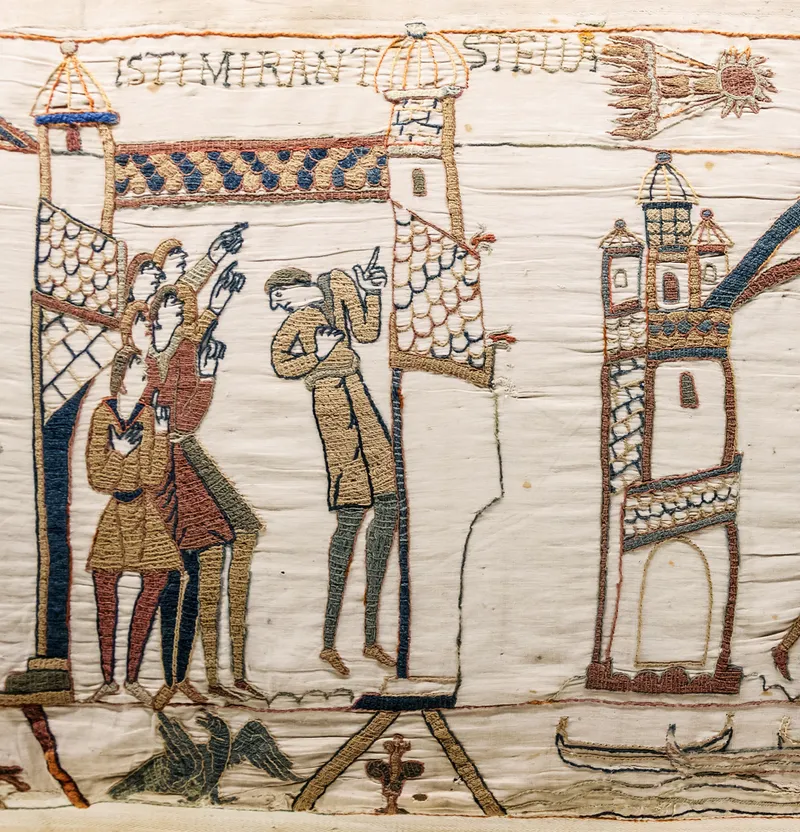
- What: The Bayeux Tapestry includes a famous comet scene that historians identify as Halley’s Comet, linking the 1066 Norman Conquest to a real astronomical event.
- Where: The Bayeux Tapestry, in medieval Normandy/England context.
- When: 1066, just before the Battle of Hastings and the Norman Conquest.
One of the most famous images in the Bayeux Tapestry is not a king or a battle. It is a comet streaking across the sky. Modern historians generally identify it as Halley’s Comet, which was visible in 1066, the same year England’s throne was contested and William of Normandy invaded.
In the embroidery, the object appears above a group of figures looking upward, with a short Latin caption noting that people “marvel” at the star. The scene comes before the Battle of Hastings, placing the comet within a larger story about power, legitimacy, and sudden change. It is a small image compared with the military scenes that follow, but it stands out because it connects the tapestry to a real astronomical event with a known date.
Halley’s Comet in 1066
Halley’s Comet did pass by Earth in 1066. That part is not in doubt. What is harder to pin down is exactly how different people at the time interpreted it. Medieval writers often treated unusual events in the sky as signs, but reactions were not identical everywhere, and the tapestry itself was created after the conquest, likely from a Norman viewpoint. That means the comet scene is not just a record of something seen in the sky. It is also part of a political narrative about what 1066 meant.
That is what makes the image so effective. An embroidered strip made to tell the story of conquest includes a phenomenon that modern astronomy can identify with confidence. The makers did not know it as “Halley’s Comet” in the modern scientific sense, but they recognized it as extraordinary enough to include. For medieval audiences, a comet could suggest disruption or divine warning. For modern viewers, it also serves as a timestamp.
Bayeux Tapestry Comet Meaning
The broader context matters. The Bayeux Tapestry is often read as a visual account of the Norman Conquest, but the comet shows how closely medieval history could blend observed reality with interpretation. A bright object appears in the sky; then a kingdom changes hands. The connection was meaningful to contemporaries, even if no definitive proof can show a single shared reaction among everyone who saw it.
So the comet in the Bayeux Tapestry works on two levels at once. It preserves a likely sighting of Halley’s Comet over 11th-century Europe, and it shows how one embroidered image helped frame the upheaval of 1066 as something written not only in politics and battle, but in the sky.
Did You Know?
Halley’s Comet was famously visible again in 1986, when it last returned to the inner Solar System.