🌍 Records from the halls of power
7 Border Oddities Where Daily Life Crosses Countries
- What: This list highlights unusual border arrangements where political boundaries shape everyday life by cutting through towns, access routes, or shared spaces.
- Where: Mainly Europe, with one example from the U.S.–Canada border region and one in North Africa.
- When: Contemporary daily life shaped by historical border and treaty decisions.
Some international borders lie far from ordinary routines. Others cut straight through them.
These seven border oddities show what happens when a line on a map runs through streets, access roads, or entire settlements. In these places, everyday life can brush up against two legal worlds at once.
1. Baarle’s checkerboard (Belgium/Netherlands)
Baarle-Hertog is the famous example of a border turned into a maze. Belgian enclaves sit inside the Netherlands, and the line can run along shopfronts and through buildings.
The surprising part is how practical that becomes. A house’s front door can determine which country it belongs to, shaping which services apply. In this village, the border is not a distant checkpoint. It is part of the street itself.
2. Point Roberts (USA) — a U.S. community only reachable by land via Canada
Point Roberts is part of Washington state, but by land it is separated from the rest of the United States. Its road connection goes through Canada.
That makes ordinary travel unusually complicated. A routine trip to the rest of Washington means crossing the U.S.–Canada border twice, turning a simple drive into an international journey.
3. Campione d’Italia (Italy in Switzerland)
Campione d’Italia is an Italian town entirely surrounded by Swiss territory. On paper, it remains under Italian jurisdiction, but daily life has long relied on nearby Swiss infrastructure and services.
That is what makes it so striking. The town is politically Italian, yet its practical rhythms are shaped by the country around it. The border here is not just a line of sovereignty. It is a constant condition of daily life.
4. Llívia (Spain inside France)
Llívia is a Spanish town enclaved within France. Its unusual status is tied to treaty wording that distinguished “towns” from “villages,” allowing this one place to remain Spanish.
The result is a settlement separated from its own country by foreign territory. Its link to Spain comes via a special road across France, so even the route home reflects an old border decision that still matters on the ground.
5. Jungholz (Austria joined to the rest of Austria at a single point)
Jungholz is an Austrian village with an extraordinary geographical twist: it connects to the rest of Austria only at the Sorgschrofen summit, a single point.
In practical terms, road access goes through Germany. That means daily travel and trade follow the easier route, even though the village is Austrian. On a map, it touches Austria; in everyday movement, it leans outward.
6. Pheasant Island (a two-country jointly administered island)
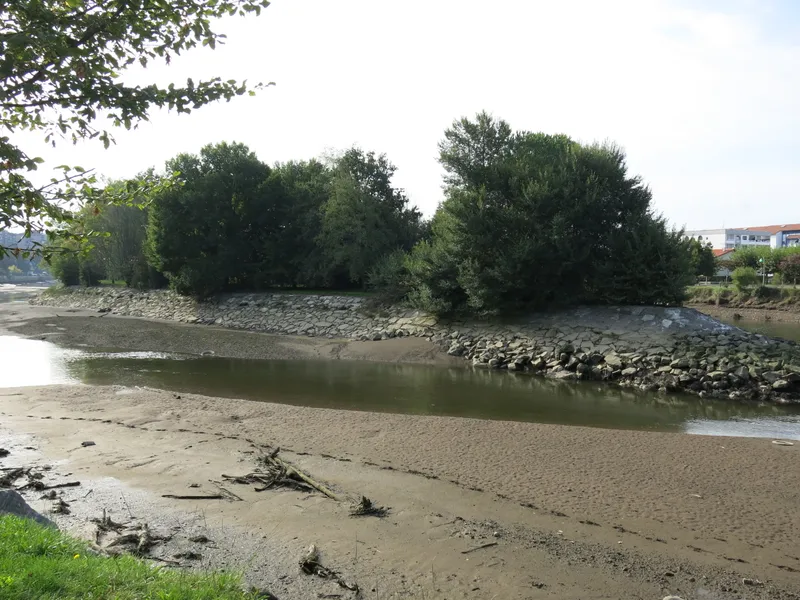
Pheasant Island, or Isla de los Faisanes, is tiny and uninhabited, but its political arrangement is unusually large in concept. It is jointly owned and administered by France and Spain.
Even more surprising, that administration alternates in six-month terms. Most borders divide. This one creates a place where sovereignty is shared on a schedule, making a small river island one of the strangest border arrangements in Europe.
7. Ceuta (Spanish city on Africa’s coast)
Ceuta is a Spanish autonomous city on the African mainland, bordering Morocco. It operates with Spanish institutions and uses the euro, despite sitting across the Strait from mainland Spain.
Its position makes the border especially visible. This is not just a distant overseas possession in the abstract; it is a city where everyday urban life exists directly behind an external EU border fence.
Taken together, these places show that borders are not always neat edges. Sometimes they run through front doors, across access roads, or into the routines of people simply trying to get through the day.
Did You Know?
Pheasant Island is often described as the world’s smallest condominium, a territory jointly governed by two countries.