
🧪 Echoes from the lab
Kelso Dunes Booming Sand Happens Only Under Specific Conditions
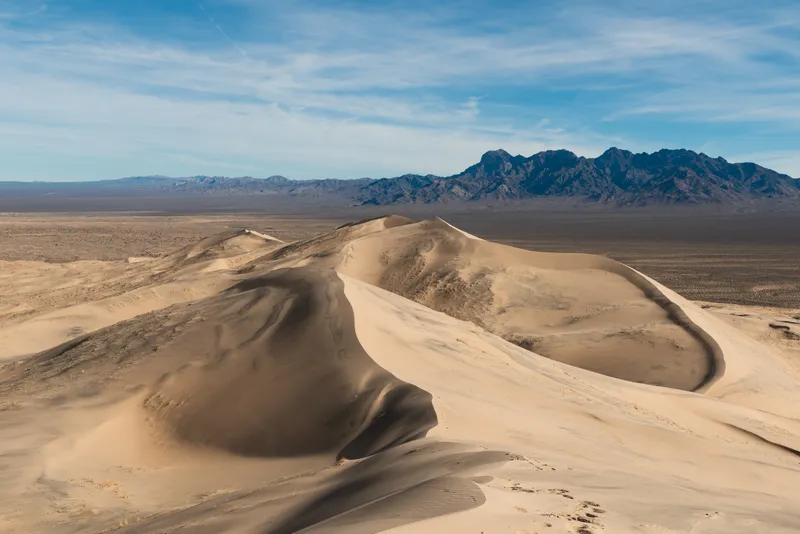
- What: Booming dunes make a deep sound only when a thin, very dry layer of similarly sized sand grains slides at an appropriate speed and moves in synchrony.
- Where: Kelso Dunes in California’s Mojave Desert.
- When:
At California’s Kelso Dunes, sand avalanches can produce a deep booming sound, but only under narrow physical conditions. The dunes do not roar every time sand slides.
Conditions for Booming Sand
If the surface layer is thin, very dry, and made of grains that are close to the same size, an avalanche can organize itself in a way that turns a simple slide into a loud, sustained tone. If those conditions are missing, the sand usually just slips downhill with an ordinary rustle.
That is the key to the so-called booming dunes of the Mojave Desert. Researchers have found that the sound depends on a shallow sheet of moving sand traveling within a certain speed range. When that happens, many grains begin moving in near synchrony. Instead of countless tiny random collisions canceling one another out, the motion lines up enough to create a low-frequency vibration that can be heard across the dune.
The effect is sometimes described as the dune singing, but the sound is not coming from some hidden chamber inside the hill of sand. It is a mechanical result of grain motion at the surface and just below it. The avalanche acts less like a pile collapsing and more like a thin, flowing layer that briefly locks into a shared rhythm.
Why Some Avalanches Stay Silent
That also explains a common misconception: steep sand alone is not enough. A large slide, a hot day, or a dramatic desert setting does not guarantee booming. Moisture can disrupt the effect. Mixed grain sizes can disrupt it. The moving layer also has to reach the right flow behavior. Without that combination, there is no roar.
Kelso Dunes is one of the best-known booming dune sites in North America, but the phenomenon has been studied at other dunes around the world as well. The details can vary by location, and scientists have debated exactly how the synchronization develops, but the broad result is consistent: the sound requires unusually specific grain and flow conditions.
How Kelso Dunes Produce Sound
So the hard fact is simple. At Kelso Dunes, booming is not a general property of sand avalanches. It appears when a thin, dry sheet of similarly sized grains slides at an appropriate speed and moves in synchronized enough fashion to generate the audible roar.
Did You Know?
Booming sand has been reported at dunes in several deserts worldwide, including in parts of Asia and Africa.