
🧪 Echoes from the lab
Bacillus subtilis Biofilms Use Potassium Waves to Coordinate Cells
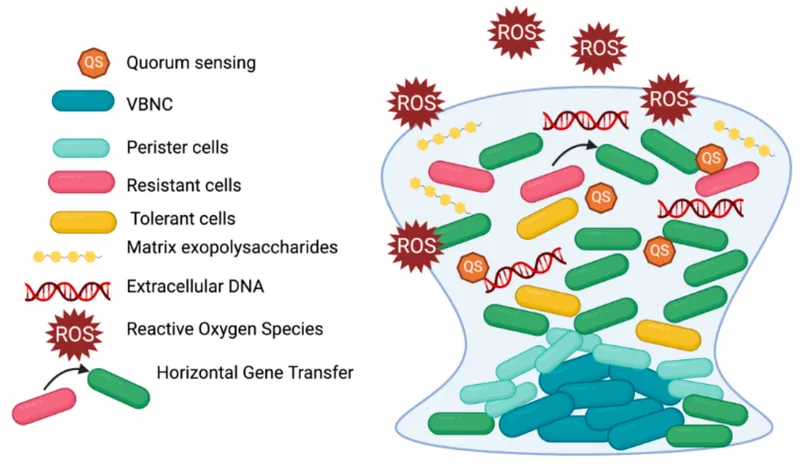
- What: Bacillus subtilis biofilms can coordinate colony-wide behavior with potassium-based electrical waves that help regulate metabolism and nutrient use across many cells.
- Where: In surface-attached bacterial biofilms.
- When: Laboratory studies reported in the 2010s.
Bacillus subtilis biofilms can send colony-wide potassium waves that help coordinate metabolism across many thousands of bacterial cells. That finding matters because it shows electrical signaling is not limited to animals with nerves. In a bacterial community, ion-based signals can travel across the biofilm and change how distant cells behave.
How Potassium Waves Spread
The basic setup is surprisingly physical. A biofilm is a dense, surface-attached community of bacteria embedded in a self-produced matrix. Cells on the outside usually have better access to nutrients. Cells deeper inside can become starved. In Bacillus subtilis, researchers found that metabolic stress in one region can trigger the release of potassium ions. That creates an electrical signal that spreads through the colony as neighboring cells respond to the changing ion environment.
The effect is not just local noise. The potassium wave can alter membrane potential across the biofilm and influence how cells take up nutrients, including glutamate, a key metabolic input in these experiments. In practice, that means the colony can shift between growth states in a coordinated way instead of acting like a collection of isolated cells. The signal links metabolism in one area to metabolic activity somewhere else.
Biofilm Oscillations Under Stress
A useful example came from laboratory studies in the 2010s, including work associated with Gürol Süel and colleagues in the United States. In those experiments, Bacillus subtilis biofilms showed oscillations tied to nutrient limitation. When the center of the biofilm became stressed, potassium-mediated signaling helped communicate that condition outward. Peripheral cells then reduced nutrient consumption, which could ease pressure on the starved interior. The whole colony behaved like a connected system.
What the Signaling Means
The key misconception is that this means bacteria have something like a brain or a primitive nervous system in the animal sense. They do not. There are no neurons here, no synapses, and no evidence of thought or awareness. What exists is electrical communication based on ion flow and membrane changes, used for collective regulation. The comparison to nervous communication is about mechanism at a very broad level, not about mental function.
The concrete implication is that a biofilm on a surface is not just a pile of microbes growing independently. In Bacillus subtilis, it can operate through measurable electrical coordination, with potassium waves helping distribute metabolic consequences across the colony. That makes biofilms more understandable as organized biological systems and gives researchers a clearer target when studying microbial behavior, nutrient competition, and possibly future biofilm control strategies.
Did You Know?
Potassium is also essential for maintaining membrane potential in many living cells, including human nerve cells.