
🧪 Echoes from the lab
Greenland Ice Cores Preserve a Nuclear Fallout Timestamp
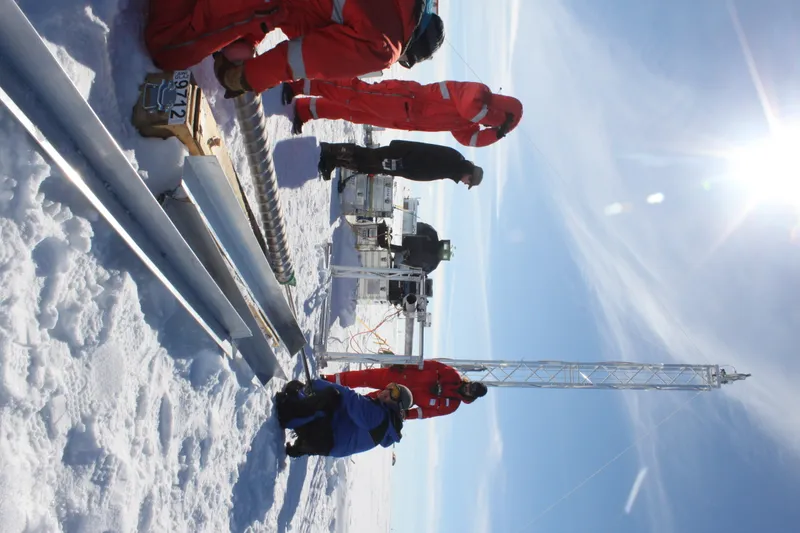
- What: Greenland ice cores preserve a distinct fallout layer from mid-20th-century atmospheric nuclear testing that scientists use as a dating marker.
- Where: Greenland ice sheet
- When: Late 1950s through 1963, especially before the 1963 Partial Test Ban Treaty
Greenland ice cores contain one of the clearest global timestamps of the nuclear age. In snow layers that formed during the 1950s through 1963, scientists see a sharp rise in radioactive fallout markers such as chlorine-36, tritium, and plutonium-239 from atmospheric nuclear testing.
How Ice Cores Record Fallout
That matters because an ice core is not just frozen water. It is a year-by-year archive. Snow falls, compresses, and turns into ice, trapping chemicals from the air as it goes. Most of the time, researchers date those layers by counting annual bands and matching signals like seasonal dust or volcanic ash. But the bomb-fallout peak is different. It is abrupt, widespread, and tied to a known historical window, which makes it an unusually useful reference point.
In Greenland, that signal stands out. Atmospheric nuclear tests conducted mainly in the Northern Hemisphere injected radionuclides high into the atmosphere, and they later settled onto snow and ice far from the test sites. When scientists drill deep into the Greenland ice sheet and measure those layers, they can spot the fallout pulse from the late 1950s to early 1960s, with the strongest peak often associated with the period just before the 1963 Partial Test Ban Treaty ended most above-ground testing.
Nuclear Fallout Peak in Greenland
The value is practical, not symbolic. If a researcher is trying to determine which year a section of ice formed, this fallout horizon acts like a fixed marker inside the core. It helps check whether annual layer counts are correct. It can also tighten the dating of nearby layers, which is essential when scientists are reconstructing snowfall rates, atmospheric circulation, pollution histories, or the timing of climate shifts.
The consequence is precision. A distinct chemical pulse left by mid-20th-century nuclear testing lets scientists line up Greenland ice records with real calendar years more confidently than they could by visual layering alone. That improves the accuracy of studies that depend on precise timing, especially when small dating errors can distort trends over decades.
Why the Fallout Horizon Matters
So when a lab identifies the bomb-fallout peak in a Greenland core, it is not reading a metaphor. It is locating a specific horizon in the ice, anchored to roughly 1950s to 1963 fallout, and using that frozen timestamp to date the surrounding record with much tighter control.
Did You Know?
A widely used fallout marker is often called the “bomb spike,” and it appears in environmental records far beyond ice cores.