
🌍 Records from the halls of power
Hiroshige's Tōkaidō Prints Helped Shape Edo Tourism
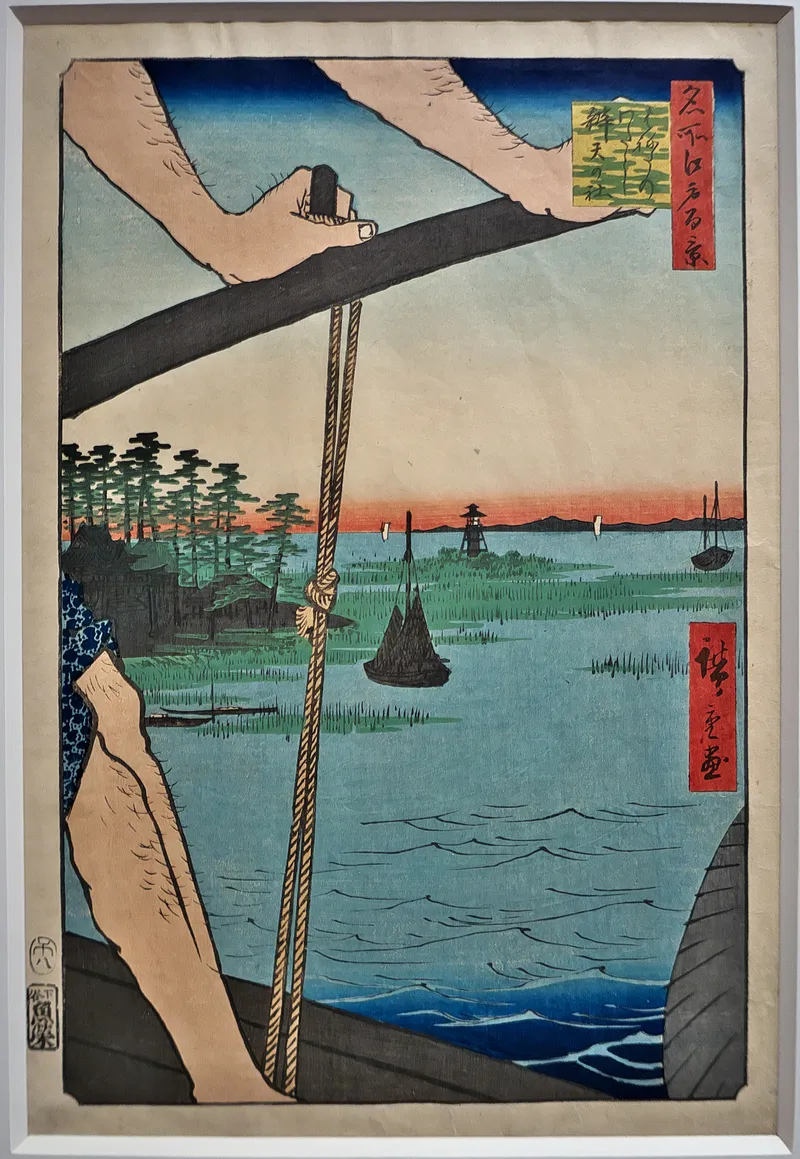
- What: Hiroshige’s Tōkaidō woodblock prints helped turn specific stations, teahouses, and views into memorable travel destinations for Edo-period travelers.
- Where: The Tōkaidō road linking Edo and Kyoto, especially Mariko’s Chōjiya teahouse.
- When: The 1830s, during the Edo period.
Hiroshige’s Tōkaidō prints were not just pictures of a famous road in Japan. In the 1830s, they also worked like visual prompts for travel, helping fix certain stations, views, and shops in the minds of Edo-period travelers.
Tōkaidō Prints and Travel Memory
The basic idea is simple. The Tōkaidō, the route linking Edo and Kyoto, was already a major highway in Japan. People traveled it for official duties, trade, pilgrimage, and personal reasons. Hiroshige’s print series, especially The Fifty-Three Stations of the Tōkaidō, turned that road into a set of memorable scenes. A traveler did not just think of “station 20” or “a rest stop.” They could think of a rainstorm at Shōno, a bridge at Nihonbashi, or a teahouse at Mariko.
That matters because images can shape demand. Popular woodblock prints circulated widely in urban Japan. They were affordable, collectible, and easy to recognize. No definitive proof shows that one print directly caused a surge of visitors to one exact business, but the broader effect is plausible and widely discussed: the prints increased the fame of specific places and likely encouraged travelers to seek them out.
Mariko’s Chōjiya Teahouse
Mariko’s Chōjiya teahouse is a clear example. Hiroshige depicted the station of Mariko with travelers stopping at a rustic teahouse associated with tororo-jiru, a yam soup that became the local specialty. Chōjiya itself has long tied its identity to that station image. It is difficult to measure how many customers came because of the print alone, but the connection between the picture, the place, and the food was strong enough to last far beyond the Edo period.
How Prints Shaped Edo Tourism
This is the key consequence: Hiroshige’s prints did not merely record famous stops on the Tōkaidō. They helped stabilize which stops became famous in the first place, and what visitors expected to find there. A roadside station became a scene. A scene became a destination. A destination could then support real businesses, from teahouses to souvenir sellers.
So the prints functioned less like neutral landscape art and more like a shared visual map of where to pause, what to notice, and what counted as worth seeing. In practical terms, that meant places like Mariko’s Chōjiya were not only on the road between Edo and Kyoto. They were on the itinerary people carried in their heads.
Did You Know?
Hiroshige made a famous Tōkaidō series, The Fifty-Three Stations of the Tōkaidō, which helped make him one of the best-known ukiyo-e artists.