🚀 Whispers from the silent cosmos
7 Asteroids Showing YORP-Linked Spin-Up in Action
- What: This list explains how the YORP effect—tiny torques from sunlight—has been observed or strongly inferred to alter asteroid spin, surface stability, and in some cases trigger mass shedding, binary formation, or breakup.
- Where: On small asteroids in the Solar System, including near-Earth objects and objects in the asteroid belt.
- When: Modern astronomical observations, mainly in the late 20th and early 21st centuries.
Some asteroids do not just orbit in sunlight. They are slowly twisted by it.
This effect is called YORP, and on small bodies it can change spin rates, destabilize loose surface material, and in extreme cases help drive shedding, fission, or breakup. Here are seven concrete asteroid cases where that process has been measured or is strongly implicated.
1. (54509) YORP — the poster child for sunlight spin-up
Formerly known as 2000 PH5, this small asteroid became the clearest case of YORP in action. Its rotation was directly measured to be accelerating, meaning its day was getting shorter.
That mattered because it turned a theoretical effect into an observed one. Sunlight alone was enough to measurably change how a real asteroid spins, and the object was eventually renamed 54509 YORP for exactly that reason.
2. Bennu’s changing spin and pebble shedding
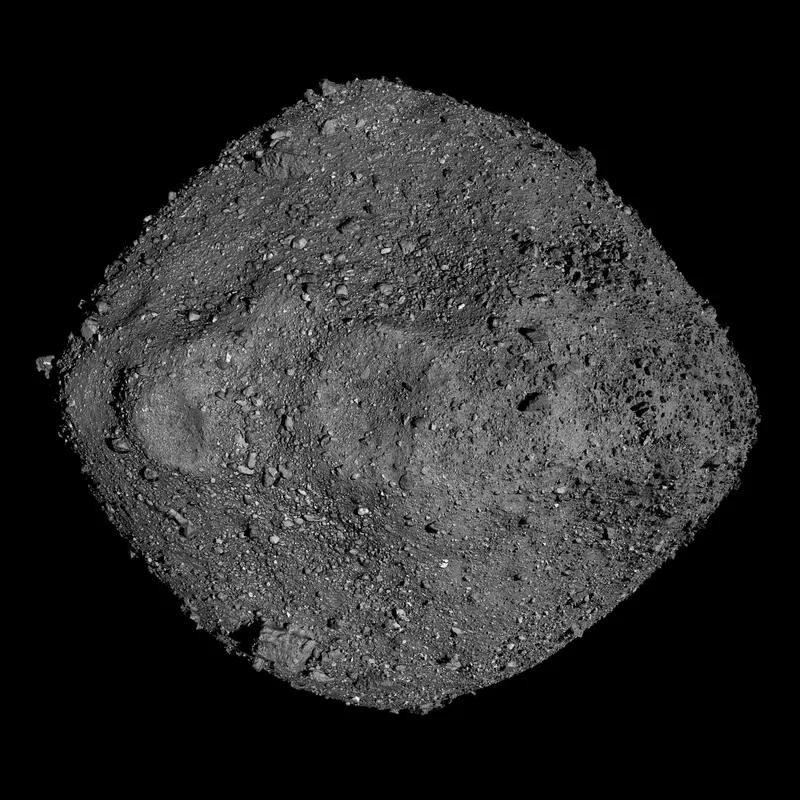
Bennu is one of the most closely watched small bodies in space, and its rotation rate has been measured to increase over time in a way consistent with YORP. Then OSIRIS-REx saw something even stranger: particles being ejected from the asteroid.
The ejections were likely tied to meteoroid impacts or thermal effects, not definitively to spin alone. But faster rotation changes surface stability, so Bennu became a vivid example of how YORP-linked spin evolution can interact with a fragile rubble-pile surface.
3. P/2013 R3’s breakup likely from rotational overload
Hubble Space Telescope observations showed P/2013 R3 splitting into multiple fragments. Instead of one clean impact scar or clear explosive outgassing, the pieces drifted apart in a way that fit rotational disruption.
That is the eerie part: a small body may have spun itself apart. The leading explanation is sunlight-driven spin-up pushing it past its structural limit, turning one object into several.
4. 311P’s episodic tail episodes tied to spin
311P did not show just one dust tail. It showed multiple tails appearing in staggered episodes, which is a strange pattern for a small body.
The best fit is repeated mass shedding from an asteroid near rotational instability. YORP is a plausible driver of that spin-up, making 311P look less like a one-time event and more like a body repeatedly losing material as it approaches the edge.
5. 288P — a binary born of spin
288P is especially intriguing because it is a resolved equal-mass binary with dust activity. Its overall properties point toward rotational fission, where a fast-spinning body separates into two components.
In this case, spin-up was likely driven by YORP and possibly also by sublimation torques. The result is a system that appears to preserve the aftermath of a body spun into a binary configuration.
6. 1999 KW4 — a binary shaped by fast rotation
The near-Earth asteroid pair 1999 KW4 has a top-shaped primary and mutual dynamics that fit a past spin-fission scenario. It looks like a system shaped by extreme rotation.
There is no direct YORP measurement here in the supplied evidence, so the link is more cautious. But YORP remains a plausible spin-up driver behind the fast rotation that likely helped produce the binary architecture.
7. Geographos and long-term lightcurve drift
1620 Geographos shows how patient observation can reveal subtle change. Across decades of lightcurve data, astronomers found a measurable drift in spin rate consistent with YORP.
It is not as visually dramatic as a breakup or dust tails, but it is powerful evidence. A tiny torque from sunlight, acting over long periods, can leave a detectable fingerprint on the rotation of a real asteroid.
Taken together, these seven cases show the same unsettling pattern: sunlight does not merely illuminate small asteroids. Given enough time, it can reshape their spin, their surfaces, and sometimes their fate.
Did You Know?
YORP is named after four researchers: Yarkovsky, O’Keefe, Radzievskii, and Paddack.