🧪 Echoes from the lab
7 Microbe-Made Color Scenes Visible From Satellites
- What: This list highlights how microbial activity can create or alter striking natural colors in water, ice, and mineral-rich environments, sometimes at scales visible from satellites.
- Where: Across Earth’s oceans, coasts, salt lakes, glaciers, rivers, and mineral-rich inland waters.
- When: In the present day, as recurring natural or human-impacted environmental phenomena observable with modern satellite imagery.
Some of Earth’s boldest colors are not painted by rock alone. They are made, amplified, or transformed by microbes.
From Spain’s iron-red river to milky turquoise seas and pink salt lakes, these microbial color scenes are strong enough to alter satellite imagery. Here are seven places and bloom types where microscopic life changes the view from orbit.
1. Rio Tinto, Spain — a microbially driven iron-red river
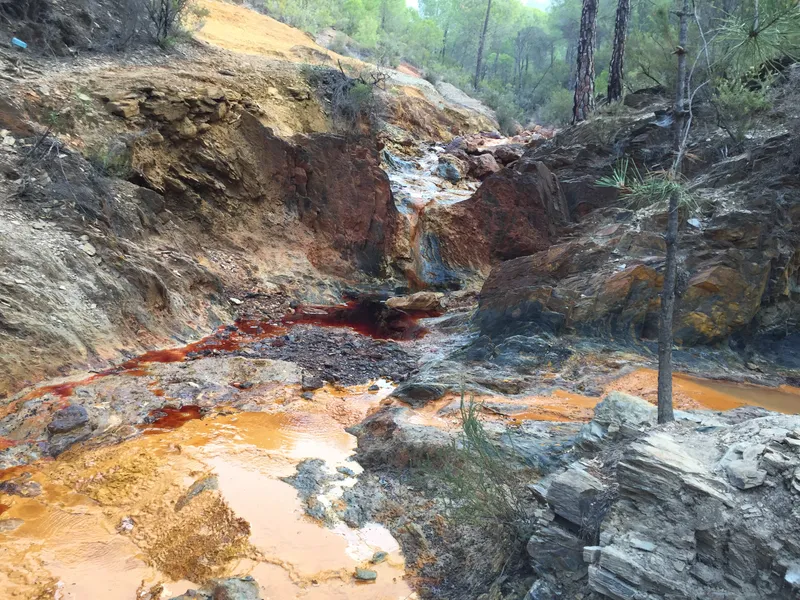
In southwestern Spain, Rio Tinto is famous for waters and banks stained deep red. The color is tied to extreme acidity and high ferric iron and iron-mineral loads.
The striking part is that iron- and sulfur-oxidizing microbes help drive the chemistry behind that color. The result is a scarlet watershed so broad and intense that it stands out clearly in satellite imagery.
2. Pink salt lakes — Dunaliella blooms and halophiles
Across salt lakes and evaporation ponds, water can turn vivid pink instead of blue. That color appears when Dunaliella salina and halophilic archaea build up pigments such as beta-carotene and bacterioruberin.
These are not subtle tints. In the right conditions, the pink forms bold blocks and bands that are obvious from orbit, making salt landscapes look almost artificial in satellite images.
3. Coccolithophore ‘chalk’ blooms — oceans turning milky turquoise
Sometimes entire stretches of ocean shift to a pale, glowing turquoise. This happens during large coccolithophore blooms, when these microbes shed tiny calcite plates.
Those plates backscatter light so strongly that the sea can look milky or chalky from space. It is one of the clearest examples of microbes changing not just color, but also the optical signal satellites record.
4. Orange–red Noctiluca tides
Coastal water can also shift toward bright orange-red when Noctiluca scintillans blooms spread across the surface. These events can cover tens to hundreds of kilometers.
That scale is why satellites often capture them. Beyond the color, the blooms matter because they can disrupt local fisheries, turning a dramatic visual event into an ecological and economic one as well.
5. Green and red glaciers — snow/ice algae darken the cryosphere
Glaciers do not always stay white. Snow and ice algae can bloom across frozen surfaces, adding green or red tones to snowfields and ice.
That color shift matters because it lowers albedo, meaning the surface reflects less sunlight. Large blooms have been detected and mapped in satellite data, showing that even the cryosphere can be visibly reshaped by microbes.
6. Cyanobacterial mats in karst lakes and sinkholes
In shallow, clear basins such as karst lakes and sinkholes, cyanobacterial mats and biofilms can spread across the bottom and create strong cyan-to-green spectral signatures.
Where those mats are broad and continuous, high-resolution satellite imagery can detect them. The surprise is that a living film on or near the bottom can be visible from far above when water clarity and coverage align.
7. Acid-mine drainage streams where microbes ‘paint’ metal colors
Near some mine sites, streams and channels turn vivid orange, yellow, and green. These colors come from iron and sulfur minerals coating the watercourse.
Microbial consortia accelerate the oxidation of iron and sulfur, helping produce the mineral-rich runoff that remote sensing can detect. The effect looks like a chemical spill of color, but the engine behind it includes active microbial chemistry.
Seen from space, these places look unreal. Up close, the source is tiny: microbes changing minerals, pigments, and light itself on a planetary canvas.
Did You Know?
Rio Tinto has been studied as a Mars analog because its acidic, iron-rich conditions resemble environments that may once have existed on the Red Planet.