
🚀 Whispers from the silent cosmos
Xichang 1996 Long March Failure and Its Aftermath
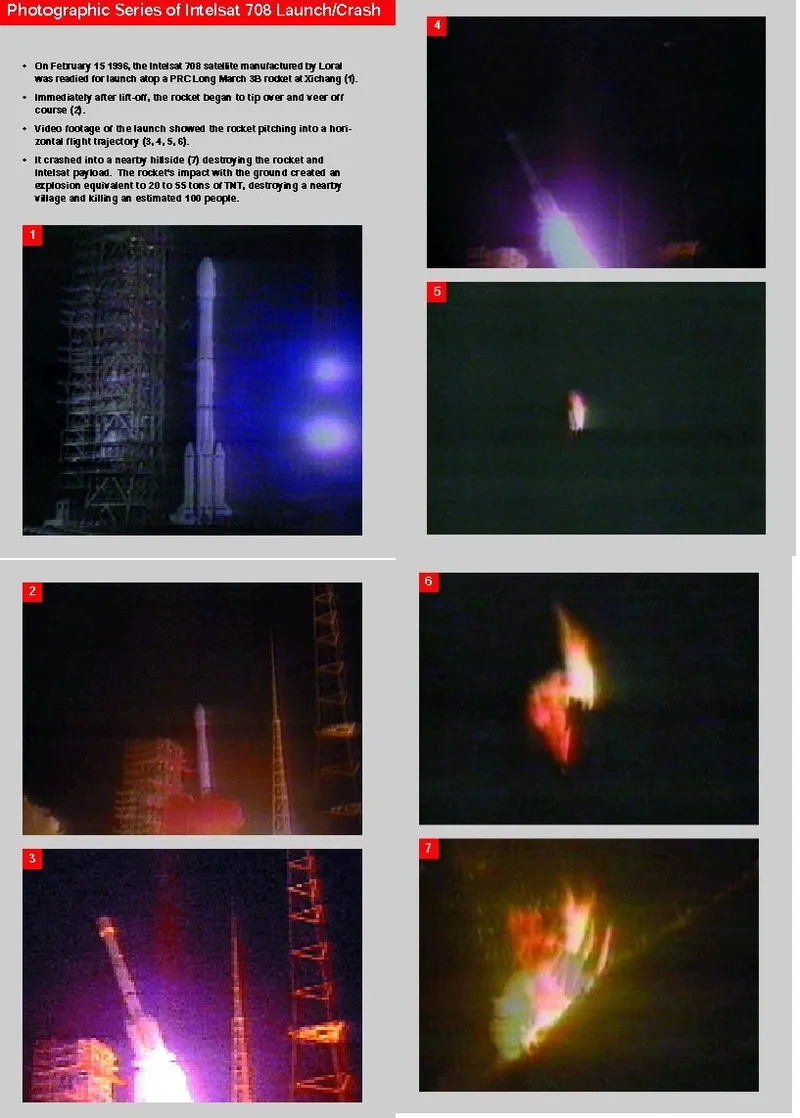
- What: A Long March 3B rocket carrying Intelsat 708 failed seconds after liftoff, crashed near the launch site, and led to scrutiny of launch safety and secrecy in China.
- Where: Xichang Satellite Launch Center, Sichuan, China.
- When: February 15, 1996.
On February 15, 1996, a Long March 3B rocket lifted off from the Xichang Satellite Launch Center in Sichuan, China, and went wrong almost immediately.
Long March 3B Crash
Seconds after launch, the rocket veered off course. It broke up and crashed near the launch site, sending debris into a populated area outside the center. Chinese authorities acknowledged civilian casualties, but the full death toll has remained disputed for decades. Some much higher numbers circulated widely afterward, but they were never definitively verified.
The launch was carrying Intelsat 708, a commercial communications satellite built for an international customer. That made the disaster unusually visible, even though detailed information from the site was tightly controlled. Images taken after the crash showed wreckage, damaged buildings, and a scene far beyond what most people imagine when they think of a failed satellite launch.
The immediate story was a rocket failure. The larger story was what it exposed. Xichang was a major launch center, but like several Cold War-era space facilities, it operated relatively close to civilian communities. When the booster failed so early, there was very little time and very little space for the danger to stay contained.
Guidance Failure and Safety Risk
Investigations later focused on a guidance-system problem during the first seconds of flight. In technical terms, it was a launch vehicle failure. In practical terms, it was a reminder that a heavy rocket leaving the pad is not just an engineering project. It is also a public-safety risk, especially when launch corridors and surrounding land are not fully isolated.
The consequence was bigger than one lost mission. The Xichang disaster helped push China to rethink how it handled launch safety, range operations, and public disclosure after accidents. Over time, Chinese launch practices placed greater emphasis on clearing downrange areas, tightening control around launches, and shifting some missions toward sites better suited for safer flight paths, including coastal facilities.
Aftermath and Chinese Launch Secrecy
It also reinforced a pattern that lasted for years: limited official detail after failures, especially when casualties or sensitive launch infrastructure were involved. That secrecy shaped how the world learned about Chinese launch accidents and why so many details from Xichang 1996 are still discussed with caution.
What happened at Xichang in 1996 was not just a failed Long March launch. It was a disaster that showed, in the most concrete way possible, that rocket safety did not end at the edge of the pad. It reached into nearby homes, and it changed how China approached the risk of launching powerful boosters near populated ground.
Did You Know?
The Intelsat 708 satellite was intended for international commercial communications service, which made the failed launch especially visible outside China.