
🏺 Recovered from the dusty archives
1783 Balloon Animal Flight That Cleared Humans for Takeoff
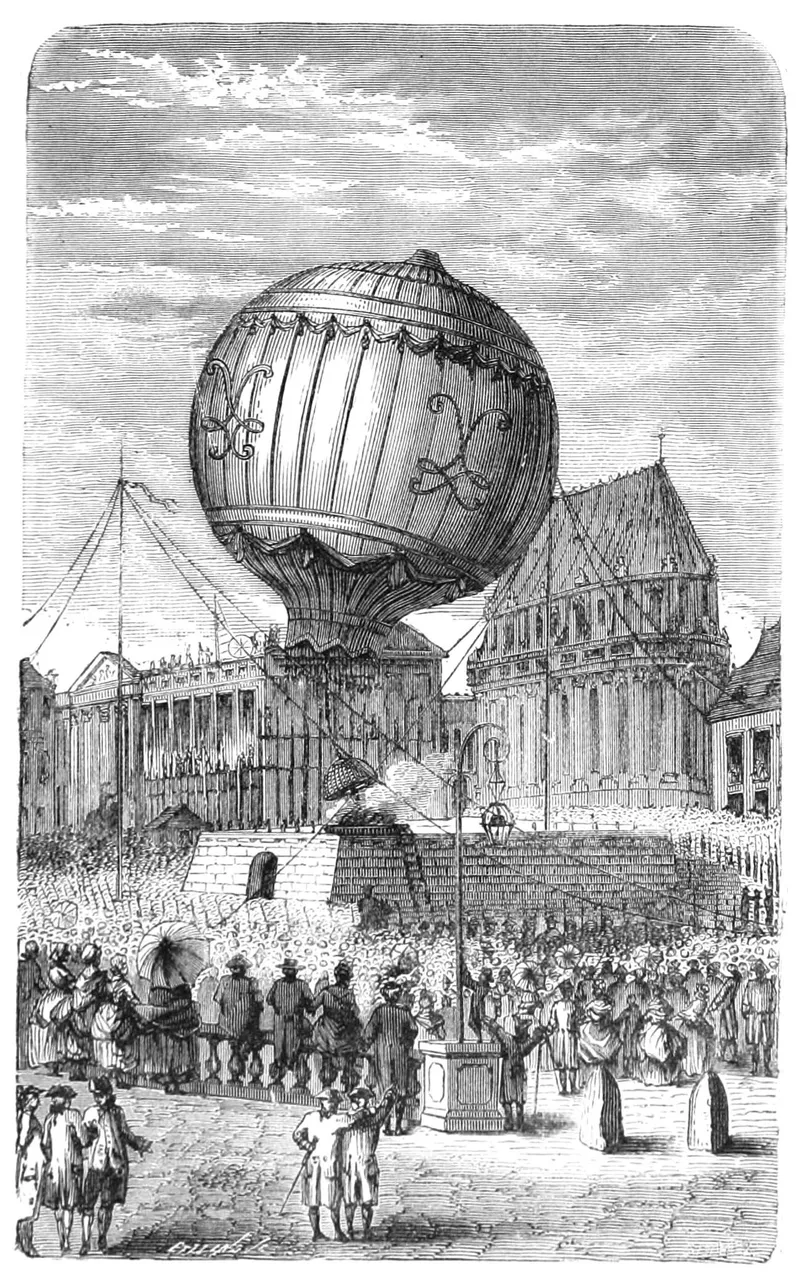
- What: In 1783, the Montgolfier brothers’ balloon test lifted a sheep, a duck, and a rooster, helping persuade observers that humans could survive balloon flight.
- Where: Versailles, France.
- When: September 19, 1783, during the early months of human ballooning.
In 1783, before anyone dared send a person into a hot-air balloon, French experimenters sent up three animals instead: a sheep, a duck, and a rooster. The flight was not a sideshow. It was a public test meant to answer a serious question: could a living body survive in the air?
Versailles Balloon Test in 1783
The demonstration took place at Versailles on September 19, 1783, using a balloon built by Joseph-Michel and Jacques-Étienne Montgolfier. A large crowd watched, including King Louis XVI and Marie Antoinette. The basket carried the animals aloft for a short flight, rising hundreds of feet before landing safely after roughly eight minutes. Contemporary reports said the sheep, duck, and rooster were found alive.
Why the Sheep, Duck, and Rooster
That result mattered immediately. Ballooning was brand new, and many people did not know what altitude, motion, or thin air might do to a body. The animal passengers were chosen to make the test legible to the public. A sheep was often treated as a stand-in for a human-sized land animal. A duck was already adapted to high altitudes in flight. A rooster, another bird but not one known for sustained high flight, added a point of comparison. The logic was simple enough for spectators to follow: if these creatures survived, then a human ascent looked less reckless.
How the Flight Cleared Human Ballooning
The experiment did not settle every scientific question, and it was not modern aerospace medicine. But it worked as evidence in the world of 1783, where spectacle, court approval, and practical demonstration often carried more weight than theory alone. The flight showed that ballooning could move from wonder to procedure. Within weeks, humans were going up. In October 1783, Pilâtre de Rozier made a tethered ascent. On November 21, 1783, Pilâtre de Rozier and François Laurent d'Arlandes made the first free human flight in a Montgolfier balloon over Paris.
The key point is not just that animals flew before people. It is that the flight at Versailles functioned as a public safety argument. The survival of the sheep, duck, and rooster gave officials and spectators a concrete result they could accept. In that sense, the first animal balloon flight was part experiment, part persuasion, and it directly helped clear the way for the first human journeys into the air.
Did You Know?
At Versailles on September 19, 1783, the Montgolfiers launched a balloon carrying a sheep, a duck, and a rooster—often cited as the first animal passengers in a hot-air balloon.