
🌍 Records from the halls of power
Teufelsberg Berlin: From Cold War Listening Station to Art Ruin
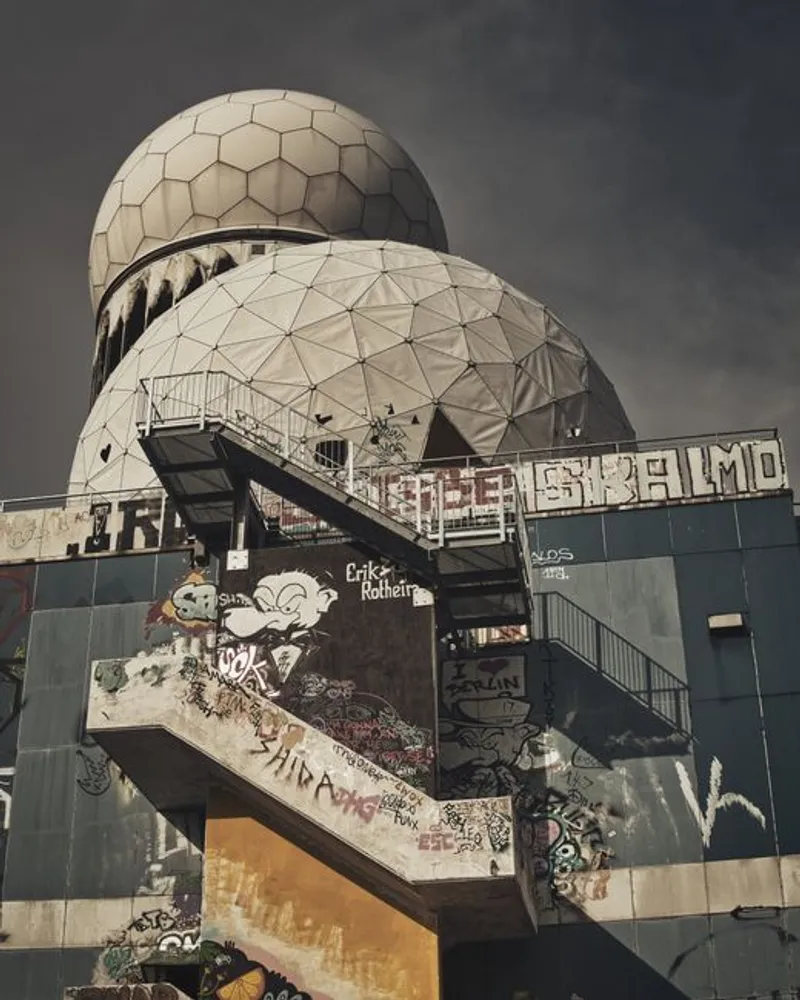
- What: Teufelsberg in Berlin is a former Cold War listening station built on a man-made hill of wartime rubble that is now known for its radomes and street art.
- Where: Western Berlin, Germany.
- When: Built and used during the Cold War; later transformed after the Cold War.
Berlin has a hill covered in graffiti and broken concrete, but its strangest feature is what sits on top: the white domes (radomes) of Teufelsberg, a former Cold War listening station that now looks half military relic, half open-air gallery.
The domes come first. Even from a distance, they look unnatural against the trees of western Berlin. Up close, the structures are more unsettling. Torn fabric hangs from the geodesic shells. Wind moves through empty corridors. Antennas and platforms sit above walls layered with spray paint, stickers, and murals. It feels like two places occupying the same site at once.
Teufelsberg Cold War History
Teufelsberg itself is already an artificial landscape. The hill was built after World War II from millions of cubic meters of wartime rubble. On that man-made rise, the United States and its allies developed a listening station during the Cold War, positioned to monitor military communications from East Germany and beyond. Much of the precise technical work carried out there remained classified for years, but the site is widely understood as part of the Western surveillance network centered on divided Berlin.
That history explains why the architecture looks so unusual. The large white domes, known as radomes, protected sensitive antennas and signals equipment from weather while helping conceal exactly what was inside. During the decades when Berlin was split, Teufelsberg was less a dramatic front line than a practical machine for collecting information. That makes its current condition even more striking: a place built for secrecy now covered in highly visible public markings.
Radomes
After the Cold War, the station lost its original purpose. Plans to redevelop the area stalled, the buildings decayed, and artists gradually transformed many surfaces with legal and semi-formal works as the site shifted into a different kind of landmark. Today, Teufelsberg is known as much for street art, tours, and its panoramic view over Berlin as for its intelligence past. Urban explorers are still drawn to it, though access rules have changed over time and unauthorized entry is not safe or lawful.
Teufelsberg Street Art Today
What makes Teufelsberg compelling is not just its appearance. In one hilltop complex, Berlin’s 20th-century layers are stacked almost literally: Nazi-era ruins buried below, Cold War surveillance above, and post-Cold War public art spread across the surface. Few places show the city’s transitions so physically.
That is why Teufelsberg remains hard to ignore. The radar domes are still there, visible above the forest, but the meaning of the place has shifted. What was built to overhear others now stands in public view as a decaying, documented landmark, where Berlin’s history can be read directly off concrete walls and abandoned equipment housings.
Did You Know?
Teufelsberg was built from millions of cubic meters of rubble after World War II.