
🚀 Whispers from the silent cosmos
Beagle 2 Mars Lander Found in Orbiter Images
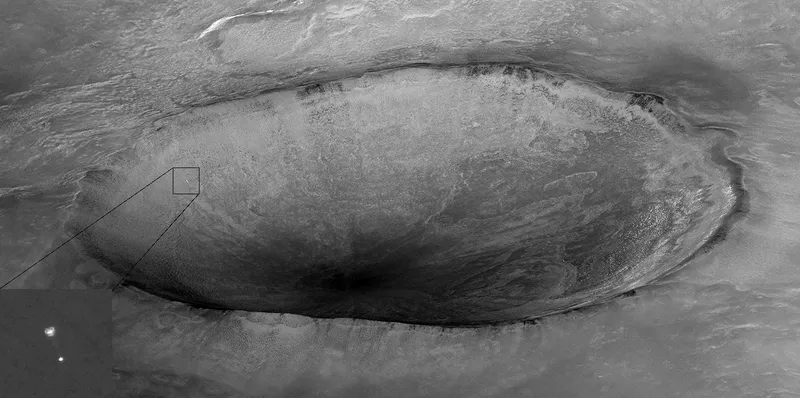
- What: Beagle 2 was later identified on Mars by NASA orbit images, showing the lander had reached the surface but failed to deploy fully and transmit.
- Where: Isidis Planitia on Mars.
- When: Launched in 2003; identified in 2015.
Beagle 2 did make it to Mars. The surprise came more than a decade later, when images from NASA’s Mars Reconnaissance Orbiter showed the missing British lander sitting on the Martian surface, partially deployed.
Beagle 2 Mission Disappearance
The spacecraft launched in 2003 as part of the European Space Agency’s Mars Express mission. Built in the UK, Beagle 2 was designed to land on Isidis Planitia on Christmas Day 2003 and search for signs of past life. But after its expected landing time, no signal came back. Repeated attempts to contact it failed, and for years its fate remained one of Mars exploration’s unresolved losses: had it crashed, bounced away, or landed intact and simply gone silent?
Mars Reconnaissance Orbiter Images
The answer began to emerge in high-resolution images taken by the Mars Reconnaissance Orbiter, which arrived at Mars in 2006 and later mapped the planet in remarkable detail. In 2015, investigators announced that Beagle 2 had been identified on the surface. The images suggested the lander had reached Mars successfully and opened at least some of its solar panels, but not all of them. That mattered because one of the panels likely blocked the radio antenna from fully deploying or transmitting properly.
So the mission appears to have failed not during the fiery descent through the Martian atmosphere, but in the last mechanical steps after touchdown. That is a very different ending from the one many had assumed. The lander was not simply lost on arrival. It seems to have survived entry, descent, and landing well enough to sit where it was supposed to work, yet remain unable to call home.
The images did not answer every question. They could not show each internal failure mode, and they did not restore contact. But they did narrow the mystery to a specific, visible problem: incomplete deployment on the ground.
Incomplete Deployment on Mars
That is the wider significance of the find. Mars missions are often judged as total successes or total failures, yet orbital imaging can recover the missing middle ground. In Beagle 2’s case, pictures from orbit turned a vanished spacecraft into a diagnosed landing attempt, with evidence precise enough to reshape how engineers understand what went wrong.
In concrete terms, Beagle 2 was not lost somewhere in deep uncertainty. It was found on Mars, in its landing region, partially opened and silent. For a mission that vanished in 2003, that visual record became the final, specific answer.
Did You Know?
NASA’s Mars Reconnaissance Orbiter, which helped identify Beagle 2, was launched in 2005 and began orbiting Mars in 2006.