
🌍 Records from the halls of power
Kochi Chinese Fishing Nets Still Work With Stones and Ropes
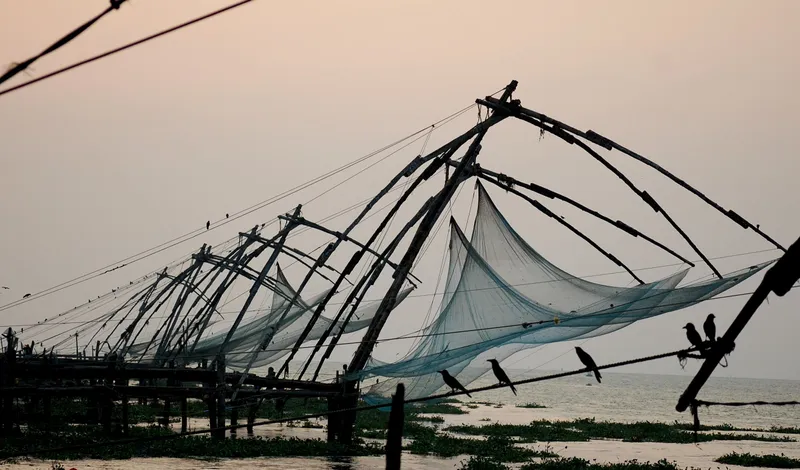
- What: The article explains how Kochi’s shore-operated Chinese fishing nets use counterweights, ropes, and pulleys to lift and lower large nets efficiently from land.
- Where: Kochi, on India’s southwest coast, especially around Fort Kochi.
- When: These nets have been in use for generations and are still operated today; their introduction from Chinese influence is described as centuries old but not precisely dated.
In Kochi, on India’s southwest coast, one of the most recognizable fishing gear is not a boat or a motor. It is the shore-operated Chinese fishing net, a large cantilevered structure that still rises and drops using ropes, pulleys, and heavy stones.
How the Nets Work
The first thing people notice is the shape. A long wooden beam projects out over the water, holding a square net below. Behind it, several ropes run upward and backward to a set of suspended stones. Those stones are the key. They act as counterweights, helping operators lower the net into the water and then lift it back up with controlled force instead of raw strain.
The system is simple to watch and slightly counterintuitive at first. The net itself is large and wet, so lifting it directly would take major effort. But by balancing the load with stone weights tied to ropes, the mechanism distributes that effort. A small team can work the structure from shore, dipping the net briefly, then raising it to check the catch. The engineering principle is basic leverage, but at this scale it becomes strikingly efficient.
Kochi Nets and Chinese Influence
These nets are commonly associated with Kochi, especially around Fort Kochi, and are widely described as having been introduced centuries ago through Chinese influence. The exact route and date are not fully documented in a definitive way, but the connection has long been part of the nets’ accepted historical identity. What is certain is that the design has remained visible in Kochi for generations and is still operated today.
Why the Fishing Nets Remain
That continued use matters because it shows something easy to miss in discussions about old technology: survival usually depends less on age than on function. The Chinese fishing nets have lasted in Kochi not because they are old, but because the mechanism still solves a real problem with local materials and straightforward physics. Wood, rope, pulley, stone, balance. No complex power source is required.
In practical terms, the nets are a working example of pre-industrial mechanical design still present in a modern coastal city. They are not symbolic machines detached from use. They are lifting systems built around counterweight logic, and that logic remains clear every time the net goes down into the water and comes back up from the shore of Kochi.
Did You Know?
Fort Kochi’s Chinese fishing nets are often operated by a small crew from shore, which is why they are one of the most photographed working fishing systems in India.