
🧪 Echoes from the lab
Apollo 17 Core Sample 73001 Opened After About 50 Years
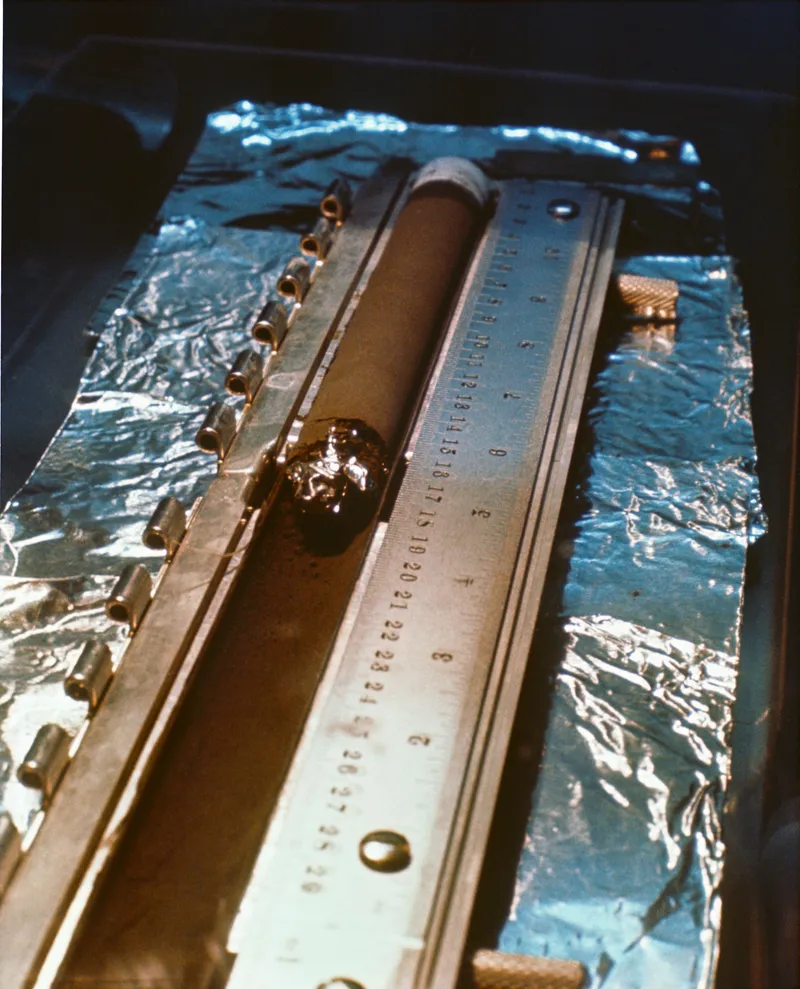
- What: Apollo 17 core sample 73001 is a rare Moon sample sealed in vacuum on the lunar surface and later opened to study trapped gases and lunar volatiles.
- Where: Taurus-Littrow on the Moon.
- When: Collected in December 1972 and opened for analysis about 50 years later, with work reported in 2022.
Apollo 17’s core sample 73001 is one of the most unusual pieces of lunar material ever brought to Earth. Collected in December 1972 at Taurus-Littrow by astronauts Eugene Cernan and Harrison Schmitt, the sample was driven into the Moon’s surface as a core tube, sealed in vacuum on the Moon, returned to Earth, and then left unopened for about 50 years.
Why Sample 73001 Mattered
What made 73001 valuable was not just the soil inside the tube. It was the headspace gas sealed above the sample. That trapped gas gave scientists a rare chance to test what volatile compounds lunar soil may have originally held before long storage, repeated handling, or exposure during earlier analysis altered the picture.
NASA finally opened the sample as part of the Apollo Next Generation Sample Analysis program, with work on the sealed containers and gases reported in 2022. Engineers and curators had to build tools and procedures specifically to extract and collect the gas without losing it. This was less like opening a box and more like carrying out a controlled forensic operation on material sealed since the last Apollo mission.
Lunar Volatiles in Sealed Core
The scientific point was straightforward. The Moon is often described as dry, but that is only partly true. Over the years, researchers have found evidence for water and other volatiles on the Moon, especially in tiny amounts bound in minerals, glasses, or surface material shaped by solar wind and micrometeorite impacts. A sample sealed on the Moon offered a direct test of what was present in the original lunar environment around that core, rather than only what remained after decades in storage.
Scientists did not present the opening of 73001 as a dramatic discovery of a hidden lunar atmosphere. The value was more careful than that. They recovered and preserved the headspace gas and began studying both the gas and the layered soil to compare modern measurements with Apollo-era expectations. Because so few lunar samples were intentionally sealed this way, 73001 is rare as a baseline record, not just as a container of dirt.
73001 as a Baseline Record
That rarity is the main insight. Most Moon rocks can be reanalyzed with new instruments, but very few can still answer the question: what was trapped in them before Earth got involved? Sample 73001 can help constrain the Moon’s native volatile history, layer by layer and gas by gas. In concrete terms, it gives lunar scientists one of their clearest preserved tests of how Apollo material originally stored volatile compounds when it was lifted straight out of the Taurus-Littrow ground in 1972.
Did You Know?
The Apollo Next Generation Sample Analysis program exists specifically to examine previously unopened Apollo samples with modern tools.