
🏺 Recovered from the dusty archives
Dejima and Sakoku: How Dutch Trade Was Controlled
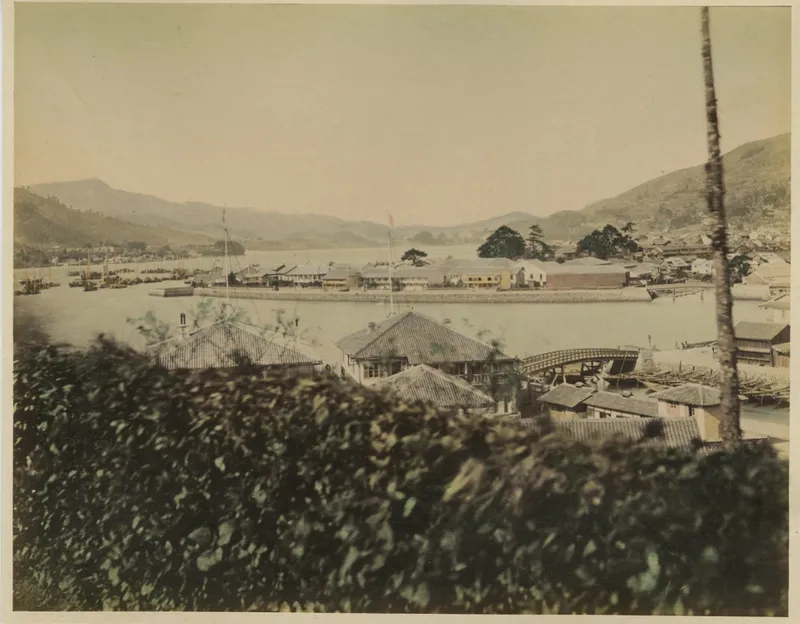
- What: Dejima was a tightly controlled Dutch trading post that let Tokugawa Japan manage foreign trade, knowledge, and outside influence without fully opening its borders.
- Where: Nagasaki, Japan
- When: Tokugawa Japan, mainly the Edo period
In Tokugawa Japan, foreign trade was not simply banned or opened. It was narrowed, monitored, and staged. The clearest example was Dejima, a small artificial island in Nagasaki where Dutch traders were confined for most of the Edo period.
Dutch Trade on Dejima
After the Portuguese were expelled in 1639, the Dutch East India Company became Japan’s main European trading partner. But that access came on strict terms. If Dutch merchants wanted to trade, they had to live inside a walled space connected to the city by a guarded bridge. They could not move freely through Japan. Japanese officials inspected goods, watched contacts, and regulated daily life. Curfews and surveillance were part of the arrangement, not side effects of it.
Dejima was built to make trade possible while limiting its political and religious risks. Tokugawa authorities were especially wary of Christianity and of foreign influence that might destabilize the shogunate. So the Dutch, who were seen as commercially useful and less threatening in religious terms than Iberian Catholics, were allowed to stay. But staying meant accepting a system designed to keep them visible, separate, and dependent on official permission.
The Dutch Journey to Edo
The most striking example of that system was the yearly journey to Edo, the shogun’s capital, a practice that continued until the late eighteenth century before becoming less frequent. If the Dutch wanted to maintain trading privileges, the head of the factory had to travel in procession to present gifts and pay formal respects to the shogun. These trips were not free diplomatic visits. They followed strict rules, fixed routes, and official expectations. The Dutch were being received, but they were also being displayed.
Dejima and the Sakoku System
That is what makes Dejima important. It shows that sakoku was not a simple sealed-border policy. Japan did allow foreign trade and foreign knowledge, including books and scientific learning later associated with rangaku, or Dutch studies. But it allowed them through a narrow gate under close supervision. The system turned international exchange into a ritual the state could manage.
The consequence was lasting. Dejima became both a trading post and a filter. Silk, sugar, medicines, instruments, and information entered Japan there, but only after passing through a framework of confinement and ceremony. On the map, Dejima was tiny. In practice, it was one of the main places where Tokugawa Japan turned contact with the outside world into something controlled, visible, and politically useful.
Did You Know?
The Dutch factory on Dejima was later used by Japanese scholars as an important source for rangaku, or "Dutch studies."